
Quinine Sulfate and Impurity Analysis with HPLC - AppNote
May 18, 2012
/
/
/
Date: 18-MAY-2012 Last Update: 15-AUGUST-2026
API Separation from Impurity without Ion-Pair ReagentsThe USP Method for Quinine Sulfate requires a Resolution of not less than 1.2 from its main impurity, Dihydroquinine. In the USP Method, the ion pair agents Methanesulfonic Acid and Diethylamine are used in the Mobile Phase. Ion pair agents are often needed to reduce peak tailing of basic analytes such as Quinine when conventional HPLC Columns are used.
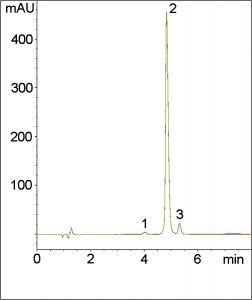
In this Method, Quinine is separated from its main impurity with a Resolution of 2.6 using only 0.1% Trifluoroacetic Acid in the Mobile Phase.
Peaks:
1. Minor impurity,
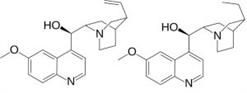
2. Quinine
(API),
3. Dihydroquinine
(Main impurity)
Column: Cogent Phenyl Hydride™, 4 μm, 100 Å
Catalog No.: 69020-7.5P
Dimensions: 4.6 x 75 mm
Mobile Phase:
- A: DI Water / 0.1% Trifluoroacetic Acid (TFA)
- B: Acetonitrile / 0.1% Trifluoroacetic Acid (TFA)
| Time (minutes) | %B |
|---|---|
| 0 | 10 |
| 6 | 30 |
| 7 | 10 |
Temperature: 40˚C
Post Time: 1 minute
Injection vol.: 10 μL
Flow rate: 1.0 mL / minute
Detection: UV @ 235 nm
Sample Preparation:
- Stock Solution: 1.0 mg Quinine (90% by label claim) was dissolved in 1 mL of 50:50 Solvent A / Solvent B mixture.
- Working Solution: A 100 μL aliquot of the stock was diluted with 900 μL of 50:50 Solvent A / Solvent B mixture.
Note: Quinine is an alkaloid found naturally in the bark of Cinchona trees. It has been known for hundreds of years as an Antimalarial agent and a muscle relaxant. The Quechua inhabitants of Peru would grind the bark of C inchona trees and mix it with sweetened water to reduce shivering in cold temperatures. Jesuits in Peru brought the bark to Europe where it was widely used to treat Malaria and became known as “Jesuit’s bark.”
