
Tetracycline HCl Capsules Stability Testing - AppNote
June 14, 2012
/
/
/
Robust, high-throughput Separation of API from its Degradation Products
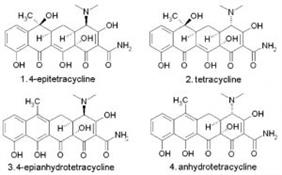
4-Epitetracycline, Tetracycline, 4-Epianhydrotetracycline, Anhydrotetracycline
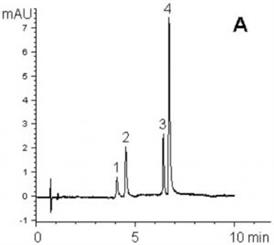
Figure A shows the chromatogram obtained from a single injection of the degraded Tetracycline capsule extract. Tetracycline is well-resolved from its three main degradation products, the identities of which were confirmed by individual standards under non-degrading conditions.
Amine-containing analytes such as these often require the use of an ion-pairing agent in the Mobile Phase in order to reduce Peak tailing from Silanolic interactions. However, ion-pairing agents often lead to poor reproducibility and long equilibration times due to slow uptake and release of these agents from the Column. In this Method, ion- pairing agents are not necessary to obtain good Peak shapes.
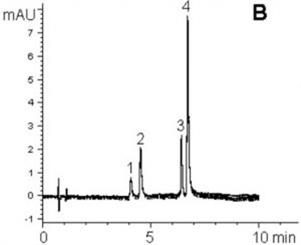
Figure B shows an overlay of five sequential injections of the degraded Tetracycline solution, illustrating the Robustness of the Method. Retention time %RSDs for all of the analytes were < 0.1%. In addition, the post time was minimal (3 minutes).
Column: Cogent Bidentate C18™, 4 µm, 100 Å
Catalog No.: 40018-75P
Dimensions: 4.6 x 75 mm
Mobile Phase:
Post Time: 3 minutes
Flow rate: 1 mL / minute
Detection: UV @ 360 nm (0–5 minutes) 430 nm (5–7 minutes)
Sample Preparation:
Notes: Tetracycline is a broad-spectrum antibiotic widely used in both human and veterinary medicine. It is known to degrade primarily by two pathways: Dehydration and Epimerization.

Attachment No 122 Stability Testing of Tetracycline HCl Capsules pdf 0.3 Mb Download File
4-Epitetracycline, Tetracycline, 4-Epianhydrotetracycline, Anhydrotetracycline
Figure A shows the chromatogram obtained from a single injection of the degraded Tetracycline capsule extract. Tetracycline is well-resolved from its three main degradation products, the identities of which were confirmed by individual standards under non-degrading conditions.
Amine-containing analytes such as these often require the use of an ion-pairing agent in the Mobile Phase in order to reduce Peak tailing from Silanolic interactions. However, ion-pairing agents often lead to poor reproducibility and long equilibration times due to slow uptake and release of these agents from the Column. In this Method, ion- pairing agents are not necessary to obtain good Peak shapes.
Figure B shows an overlay of five sequential injections of the degraded Tetracycline solution, illustrating the Robustness of the Method. Retention time %RSDs for all of the analytes were < 0.1%. In addition, the post time was minimal (3 minutes).
Peaks: 1. 4-Epitetracycline, 2. Tetracycline, 3. 4-Epianhydrotetracycline, 4. Anhydrotetracycline
Method ConditionsColumn: Cogent Bidentate C18™, 4 µm, 100 Å
Catalog No.: 40018-75P
Dimensions: 4.6 x 75 mm
Mobile Phase:
- A: DI Water / 0.1% Formic Acid
- B: Acetonitrile/ 0.1% Formic Acid
| Time (minutes) | %B |
|---|---|
| 0 | 10 |
| 4 | 30 |
| 6 | 80 |
| 7 | 10 |
Post Time: 3 minutes
Flow rate: 1 mL / minute
Detection: UV @ 360 nm (0–5 minutes) 430 nm (5–7 minutes)
Sample Preparation:
- Stock Solution: 10 mg capsule contents were diluted with 10mL 1.0 HCI and sonicated for 10 minutes. 1 mL aliquot was diluted to 20 mL with DI Water. Solution was heated at 80°C for 30 minutes.
- Working Solution: Stock Solution was then diluted to 100 mL with DI Water and filtered through a 0.45 µm Nylon Syringe Filter (MICROSOLV Technology). Stock solution was diluted 10x using 0.01N HCI diluent before injection.
Notes: Tetracycline is a broad-spectrum antibiotic widely used in both human and veterinary medicine. It is known to degrade primarily by two pathways: Dehydration and Epimerization.
Attachment No 122 Stability Testing of Tetracycline HCl Capsules pdf 0.3 Mb Download File