
Doxylamine Succinate Tablet Analyzed by HPLC - AppNote
August 13, 2012
/
/
/
Shorter Run Time than USP Method
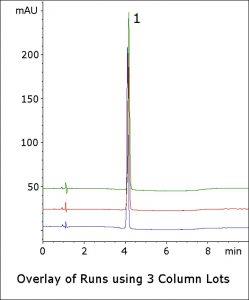
The USP Assay Method for Doxylamine Succinate tablets uses Triethylamine and Sodium Lauryl Sulfate in the Mobile Phase. These reagents are slow to fully load onto the Column, resulting in long run times and poor Robustness. This Method uses Trifluoroacetic Acid to get an excellent Peak Shape. An overlay of injections from three different lots is shown in order to illustrate the Reproducibility of this Method.
Column: Cogent Diamond Hydride™, 4 µm, 100Å
Catalog No.: 70000-7.5P
Dimensions: 4.6 x 75 mm
Mobile Phase:
-- A: DI Water / 0.1% Trifluoroacetic Acid (TFA)
-- B: Acetonitrile / 0.1% Trifluoroacetic Acid (TFA)
Gradient:
Injection vol.: 2 µL
Flow rate: 1.0 mL / minute
Detection: UV @ 254 nm
Sample Preparation: 25 mg strength Doxylamine Succinate tablet was ground and added to a 50 mL volumetric flask containing a portion of 50:50 Solvent A / Solvent B diluent. Solution was then sonicated for 10 minutes and diluted to mark. A portion was filtered with a 0.45 µm Nylon Syringe Filter (MICROSOLV Tech Corp.).
t 0 : 0.9 minutes
Note: Doxylamine is an antihistamine with sedative properties. It is used to treat insomnia and as a sleep aid for this reason. It is found in many common Over-The-Counter drug formulations.

Attachment No 198 Doxylamine Succinate Tablet Analyzed by HPLC pdf 0.5 Mb Download File
The USP Assay Method for Doxylamine Succinate tablets uses Triethylamine and Sodium Lauryl Sulfate in the Mobile Phase. These reagents are slow to fully load onto the Column, resulting in long run times and poor Robustness. This Method uses Trifluoroacetic Acid to get an excellent Peak Shape. An overlay of injections from three different lots is shown in order to illustrate the Reproducibility of this Method.
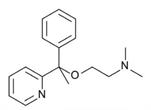
Peak:
Doxylamine
Column: Cogent Diamond Hydride™, 4 µm, 100Å
Catalog No.: 70000-7.5P
Dimensions: 4.6 x 75 mm
Mobile Phase:
-- A: DI Water / 0.1% Trifluoroacetic Acid (TFA)
-- B: Acetonitrile / 0.1% Trifluoroacetic Acid (TFA)
Gradient:
| Time (minutes) | %B |
|---|---|
| 0 | 95 |
| 1 | 95 |
| 6 | 50 |
| 7 | 95 |
Injection vol.: 2 µL
Flow rate: 1.0 mL / minute
Detection: UV @ 254 nm
Sample Preparation: 25 mg strength Doxylamine Succinate tablet was ground and added to a 50 mL volumetric flask containing a portion of 50:50 Solvent A / Solvent B diluent. Solution was then sonicated for 10 minutes and diluted to mark. A portion was filtered with a 0.45 µm Nylon Syringe Filter (MICROSOLV Tech Corp.).
t 0 : 0.9 minutes
Note: Doxylamine is an antihistamine with sedative properties. It is used to treat insomnia and as a sleep aid for this reason. It is found in many common Over-The-Counter drug formulations.
Attachment No 198 Doxylamine Succinate Tablet Analyzed by HPLC pdf 0.5 Mb Download File