
Histamine in Red Wine Analyzed with LCMS - AppNote
January 24, 2013
/
/
/
Demonstrating Low Histamine Content in Red Wine Samples
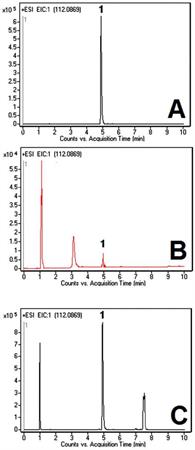
Two Red Wine samples were tested for Histamine using the Cogent Diamond Hydride Column in an LCMS method. The wine shown in Figure B was claimed to have virtually no Histamine but had no analytical evidence to support it. The claim was verified using this simple LCMS Method that produces an excellent Histamine Meak.
The other wine in Figure C had to be diluted 5x, and even still the Histamine Peak was much larger than in Figure B.
 Method Conditions
Column: Cogent Diamond Hydride™, 4 μm, 100 Å
Catalog No.: 70000-15P-2
Dimensions: 2.1 x 150 mm
Mobile Phase:
-- A: DI Water / 0.1% Formic Acid
-- B: Acetonitrile / 0.1% Formic Acid
Gradient:
Post Time: 5 minutes
Injection vol.: 1 μL
Flow rate: 0.4mL / minute
Detection: ESI – POS - Agilent 6210 MSD TOF Mass Spectrometer
Sample Preparation:

Attachment No 231 Histamine in Red Wine Analyzed with LCMS pdf 0.4 Mb Download File
Two Red Wine samples were tested for Histamine using the Cogent Diamond Hydride Column in an LCMS method. The wine shown in Figure B was claimed to have virtually no Histamine but had no analytical evidence to support it. The claim was verified using this simple LCMS Method that produces an excellent Histamine Meak.
The other wine in Figure C had to be diluted 5x, and even still the Histamine Peak was much larger than in Figure B.
The data shows that there are significant quantitative differences in the Histamine content of various wines. Observing these differences is made possible using the Cogent Diamond Hydride Column.
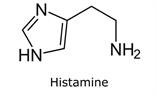
Peak: Histamine 112.0869 m/z
Column: Cogent Diamond Hydride™, 4 μm, 100 Å
Catalog No.: 70000-15P-2
Dimensions: 2.1 x 150 mm
Mobile Phase:
-- A: DI Water / 0.1% Formic Acid
-- B: Acetonitrile / 0.1% Formic Acid
Gradient:
| Time (minutes) | %B |
|---|---|
| 0 | 80 |
| 5 | 10 |
| 7 | 10 |
| 8 | 80 |
Post Time: 5 minutes
Injection vol.: 1 μL
Flow rate: 0.4mL / minute
Detection: ESI – POS - Agilent 6210 MSD TOF Mass Spectrometer
Sample Preparation:
- Fig. A: Histamine Standard
- - Fig. B: “Low Histamine” Red Wine. Sample was filtered with 0.45 μm Nylon Syringe Filter (MICROSOLV)
- - Fig. C: “Regular Red Wine. In addition to filtering, Sample was diluted 1:5 due to strong Histamine Peak
Attachment No 231 Histamine in Red Wine Analyzed with LCMS pdf 0.4 Mb Download File