Date: 21-JANUARY-2017 Last Updated 21-AUGUST-2026
Introduction
The analysis of highly polar compounds remains one of the most challenging areas of HPLC and LC-MS method development. Many analytes, including metabolites, organic acids, amino acids, pharmaceuticals, and endogenous biological compounds, exhibit limited retention in conventional reversed phase chromatography.
HILIC chromatography is widely used to address these challenges because it provides retention of polar compounds while maintaining excellent LC-MS compatibility through the use of high-organic mobile phases.
Although many columns are classified as HILIC, significant differences exist between traditional hydrophilic stationary phases and Cogent™ TYPE-C™ silica hydride columns. Understanding these differences can help explain why many laboratories achieve highly reproducible polar compound separations using TYPE-C™ technology.
Polar Compound Retention in HILIC Methods
HILIC methods generally share several characteristics:
- High acetonitrile mobile phase content
- Strong retention of polar compounds
- Excellent LC-MS compatibility
- Inverse gradient behavior
- Suitability for metabolites and highly polar analytes
From a practical standpoint, TYPE-C™ columns function as HILIC columns and are routinely used for HILIC method development. However, the silica hydride surface provides chromatographic behavior that differs from many traditional hydrophilic silica stationary phases.
Surface Chemistry Differences
Traditional HILIC phases are typically based on highly hydrophilic surfaces such as:
- Bare silica
- Amide phases
- Zwitterionic phases
- Polyol phases
These materials are often associated with the formation of a water-enriched surface region that participates in analyte retention.
TYPE-C™ columns utilize a silica hydride surface that exhibits significantly different surface characteristics. Historically, the retention mechanism associated with silica hydride materials was described as:
Aqueous Normal Phase (ANP)
Today, these separations are most appropriately classified as HILIC because they are used for polar compound retention under typical HILIC operating conditions.
Surface Hydration and Retention Stability
One of the most important distinctions between conventional hydrophilic silica phases and silica hydride phases involves the amount of water associated with the stationary phase surface.
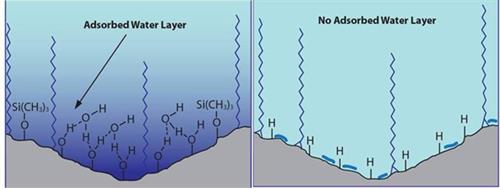
The reduced surface hydration associated with TYPE-C™ materials is believed to contribute to:
- Rapid retention stabilization
- Fast equilibration
- Excellent retention reproducibility
- Consistent chromatographic behavior
These characteristics can be particularly valuable for demanding LC-MS workflows.
Effects of Additive Concentration
Mobile phase additives are often important variables in HILIC method development.
Traditional HILIC methods frequently require significant optimization of:
- Salt concentration
- Buffer concentration
- Mobile phase strength
Changes in additive concentration can influence:
- Retention
- Selectivity
- Peak shape
- Reproducibility
TYPE-C™ HILIC methods often achieve effective retention using relatively low additive concentrations, making them particularly attractive for LC-MS applications.

Advantages for LC-MS Applications
Low additive requirements can provide several practical benefits for LC-MS laboratories.
Potential advantages include:
- Reduced ion suppression
- Improved ionization efficiency
- Lower source contamination
- Reduced maintenance requirements
- Greater instrument uptime
Many HILIC methods on TYPE-C™ columns perform well using relatively low concentrations of volatile additives such as:
- Ammonium acetate
- Ammonium formate
- Formic acid
- Acetic acid
This can simplify method development while maintaining excellent sensitivity.
Equilibration Benefits
One commonly reported advantage of TYPE-C™ columns is rapid equilibration.
Benefits may include:
- Faster startup times
- Reduced solvent consumption
- Improved throughput
- More efficient gradient operation
- Stable retention across large sample sequences
Typical equilibration requirements are often substantially shorter than many users expect when transitioning from traditional HILIC materials.
Reproducibility and Precision
For LC and LC-MS applications, reproducibility is often as important as retention.
TYPE-C™ columns are frequently selected because they provide:
- Consistent retention times
- Stable peak shapes
- Reliable run-to-run performance
- Excellent column-to-column reproducibility
These characteristics are especially valuable in:
- Pharmaceutical analysis
- Clinical research
- Metabolomics
- Bioanalysis
- Environmental testing
- Food and beverage analysis
Method Development Flexibility
In addition to HILIC operation, many TYPE-C™ stationary phases can also be used under:
- Reversed phase conditions
- Normal phase conditions
This flexibility allows method developers to evaluate multiple retention strategies while remaining on the same silica hydride platform. The result is a broader selectivity space than is often available with conventional single-mode stationary phases.
Key Takeaways
- TYPE-C™ columns are widely used as HILIC columns for polar compound analysis.
- The silica hydride surface differs significantly from conventional hydrophilic silica materials.
- Reduced surface hydration contributes to rapid equilibration and excellent retention reproducibility.
- Low additive requirements make TYPE-C™ columns particularly attractive for LC-MS applications.
- Retention and selectivity remain stable across a wide range of method conditions.
- HILIC, reversed phase, and normal phase flexibility provide powerful method-development options.
- The combination of efficiency, reproducibility, and LC-MS compatibility makes TYPE-C™ columns valuable tools for challenging polar compound separations.