Date: 16 -December-2025 Last Updated: 11-SEPTEMBER -2026
Introduction
Analytical HPLC columns represent the most critical and often the most expensive component in a chromatographic system. Protecting the column from contamination is essential for maintaining efficiency, peak shape, retention reproducibility, and overall column longevity. Two common protection devices are:
- In-line column filters
- Guard columns
When properly installed, these components work together to reduce the impact of particulate contamination and chemical fouling before contaminants can reach the analytical column.
Recommended Flow Path Configuration
For optimum column protection, components should be installed in the following order:
Injector → Cogent™ Column Filter → Cogent™ Guard Column Holder → Analytical HPLC Column
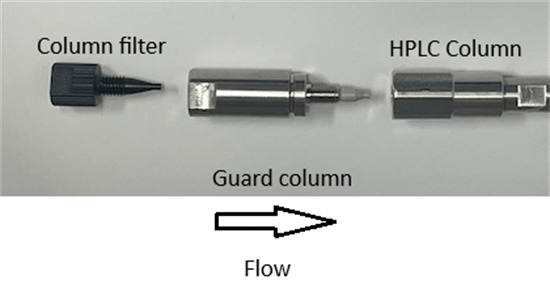
Recommended installation sequence showing the Cogent™ Column Filter positioned before the Cogent™ Guard Column Holder and analytical column. Flow direction is from the injector through the filter, then the guard column, and finally into the analytical column.
Stage One: Column Filter Protection
The Cogent™ Column Filter serves as the first line of defense against contamination entering the chromatographic system. Its primary function is to capture:
- Sample particulates
- Mobile phase contaminants
- Pump and plumbing debris
- Undissolved buffer residues
- System-generated particles
By trapping these materials before they enter the guard column or analytical column, the filter helps reduce premature blockage of column inlet frits and guard cartridges.
Stage Two: Guard Column Protection
Downstream of the column filter, the guard column provides an additional layer of protection. Unlike a simple filter, a guard column performs two functions: Mechanical Protection The guard cartridge captures residual particulates that may bypass the inlet filter. This helps protect:
- Analytical column frits
- Column inlet regions
- Stationary phase bed integrity
Chromatographic Protection
Because the guard column contains stationary phase chemistry similar to the analytical column, it can also retain dissolved contaminants that would otherwise accumulate on the analytical column. Examples include:
- Strongly retained sample components
- Matrix interferences
- Hydrophobic contaminants
- Trace impurities
These materials are retained on the replaceable guard cartridge rather than the analytical column itself.
Why Use Both a Filter and a Guard Column?
Although either device provides protection individually, combining both devices offers the most comprehensive protection. Benefits include:
- Reduced inlet frit contamination
- Reduced fouling of the analytical column
- Lower risk of unexpected pressure increases
- Improved column lifespan
- More consistent chromatographic performance
- Reduced maintenance costs
The filter addresses particulate contamination while the guard column addresses both particulate and chemical contamination.
Impact on Column Longevity
Many chromatography problems originate from contamination rather than normal stationary phase wear. Common issues include:
- Elevated backpressure
- Peak tailing
- Loss of efficiency
- Reduced sensitivity
- Changes in retention
By preventing contaminants from reaching the analytical column, a properly configured filter and guard column system can significantly extend useful column life.
Maintenance Considerations
Both filters and guard cartridges are considered consumable components. They should be monitored regularly for signs of:
- Pressure increases
- Reduced flow performance
- Peak shape deterioration
- Retention changes
Replacing a filter or guard cartridge is typically far less expensive than replacing an analytical column.
Applications
This protection strategy is particularly valuable for:
- Biological samples
- Pharmaceutical samples
- Environmental analyses
- Food and beverage testing
- Complex sample matrices
- High-throughput laboratories
These applications often expose the chromatographic system to greater contamination risks and benefit significantly from layered column protection.
Conclusion
The recommended HPLC flow path places the Cogent™ Column Filter upstream of the Cogent™ Guard Column Holder, followed by the analytical column. This configuration creates a two-stage protection system in which the filter removes particulate contaminants and the guard column protects against both particulate and chemically retained impurities. Together, these devices help maintain chromatographic performance, reduce column fouling, and extend analytical column lifetime.