
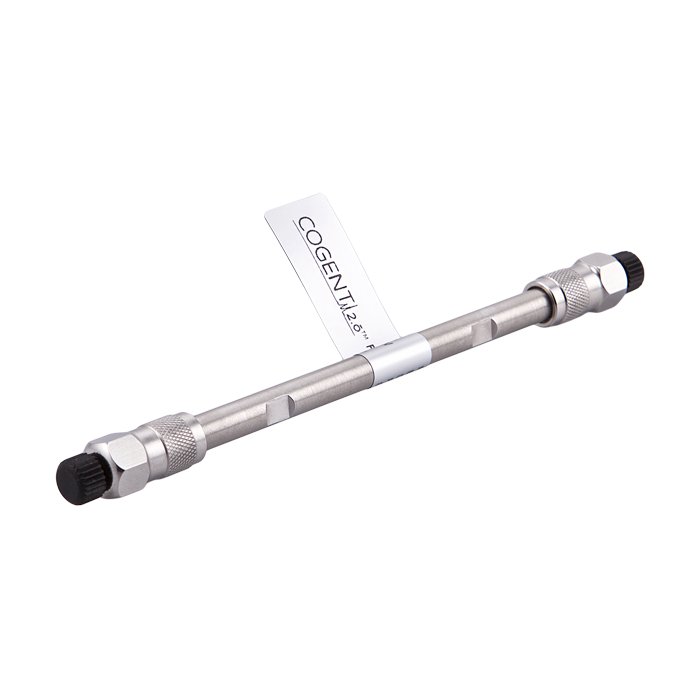
HPLC Column, Bidentate C18 2.o, 2.2um, 2.1mm ID x 100mm Length, 120A. Cogent TYPE-C Brand. 1 EA.
Additional Information:
The 40218‑10P‑2 Cogent Bidentate C18™ 2.o HPLC Column is a high‑efficiency, narrow‑bore analytical column designed for workflows that require greater resolving power than short‑length formats while preserving LC‑MS sensitivity. Built on Cogent TYPE‑C™ silica hydride technology, this column combines 2.2 µm particles with bidentate C18 bonding to deliver excellent selectivity, faster equilibration, and near‑UHPLC performance on standard HPLC instruments.
The Bidentate C18™ 2.o stationary phase is particularly effective for hydrophobic and very non‑polar compounds that are difficult to retain in aqueous mobile phases. Compared to conventional silica‑based C18 columns, the TYPE‑C™ hydride surface chemistry reduces secondary interactions, supporting more stable retention and improved peak shape under a wide range of operating conditions.
With a 2.1 mm internal diameter and an extended 100 mm length, this column provides increased plate count and separation efficiency relative to 50 mm formats, making it one of the most popular 2.o column sizes for LC‑MS when additional resolution is desired.
Why Choose the 2.1 × 100 mm Bidentate C18™ 2.o Format
This column size is commonly selected when:
LC‑MS methods require higher resolution than 50 mm columns provide
Closely eluting hydrophobic analytes must be better separated
Near‑UHPLC efficiency is desired without upgrading to UHPLC instrumentation
Retention stability is required under aqueous‑dominant or low‑pH methods
Combined with TYPE‑C™ silica hydride chemistry, the 100 mm length increases resolving power while maintaining fast equilibration and long column life.
Key Features
Cogent TYPE‑C™ Silica Hydride Technology
Reduced silanol activity and secondary interactions
Faster equilibration than conventional silica‑based C18 columns
Excellent chemical robustness and reproducibility
Bidentate C18™ 2.o Bonding
Two‑point attachment via direct Si–C bonds
Strong hydrophobic retention with controlled selectivity
Effective for very non‑polar compounds
Near‑UHPLC Efficiency (2.2 µm)
Increased efficiency compared with 3–5 µm columns
High performance on standard HPLC systems
Improved peak capacity and resolution
LC‑MS‑Optimized Geometry
2.1 mm ID enhances sensitivity and reduces solvent use
100 mm length provides higher resolving power
Well suited for ESI‑MS and LC‑MS/MS workflows
System Requirements
Due to the narrow‑bore, small‑particle format, optimal performance requires:
A pump capable of precise, stable low‑flow delivery
A detector flow cell designed for reduced internal volume
Systems not designed for low‑flow operation may not achieve full efficiency.
Typical Applications
LC‑MS and LC‑MS/MS
Hydrophobic and very non‑polar compounds
Methods requiring increased resolution
Near‑UHPLC analytical workflows
Method development and validation