
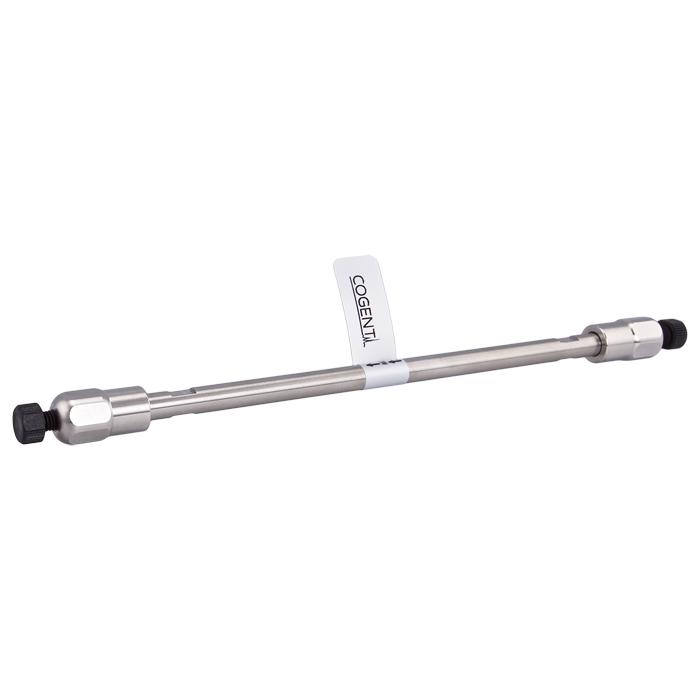
HPLC Column, RP Phenyl Hexyl, 3um, 2.1mm ID x 150mm Length, 100A. Cogent Brand. 1 EA.
Additional Information:
Cogent RP Phenyl Hexyl™ is a reversed-phase HPLC stationary phase designed to provide enhanced aromatic selectivity through strong π-π interactions while maintaining hydrophobic retention characteristics. Manufactured using a six-carbon linker with a terminal phenyl ring bonded to ultra-high purity silica and fully double end capped, this stationary phase differs from traditional Phenyl phases by positioning the aromatic functionality farther from the silica surface. This increased distance reduces silanol influence and often enhances aromatic interactions, making the phase especially useful for compounds containing benzene rings and other aromatic structures. It is commonly used as an alternative in USP methods that specify L11 chemistry or Phenyl Hexyl phases.
68339-15P-2 is an HPLC column packed with 3 µm RP Phenyl Hexyl™ particles featuring a 100 Å pore size in a 2.1 mm ID x 150 mm format. This narrow-bore configuration combines high chromatographic resolution with reduced solvent consumption and compatibility with LC-MS instrumentation. The 150 mm length provides increased peak capacity and resolving power compared to shorter column formats, while the 3 µm particles provide greater efficiency and sharper peaks than comparable 5 µm columns. Typical operating flow rates are approximately 0.2–0.3 mL/min. Standard HPLC systems used with 2.1 mm ID columns must be capable of precise and reproducible low-flow operation.
This column is especially useful for the separation of aromatic compounds with moderate hydrophobicity, where the extended C6 linker can provide selectivity differences compared to traditional Phenyl phases. Typical applications include positional isomers, tocopherols, flavonoids, polynuclear aromatic hydrocarbons, nitro-aromatic compounds, active pharmaceutical ingredients (APIs), natural products, and related compounds. The 2.1 mm ID format is well suited for LC-MS methods requiring enhanced aromatic selectivity, excellent sensitivity, and low solvent consumption. For maximizing aromatic π-π interactions, methanol is often preferred over acetonitrile as the organic modifier.
Key Benefits
RP Phenyl Hexyl™ stationary phase
USP L11 equivalent selectivity
Fully double end capped
Six-carbon linker with terminal phenyl functionality
Ultra-high purity silica support
Enhanced π-π interactions
Improved aromatic compound selectivity
3 µm particle size
Greater efficiency than 5 µm columns
Compatible with LC-MS applications
Typical Applications
USP L11 methods
LC-MS methods
Aromatic compound analysis
Positional isomer separations
Tocopherol analysis
Flavonoid analysis
Polynuclear aromatic hydrocarbon analysis
Nitro-aromatic compound analysis
Active pharmaceutical ingredient (API) analysis
Natural product analysis
Specifications
Product Type: HPLC Column
Stationary Phase: RP Phenyl Hexyl™
USP Classification: L11
Chromatography Mode: Reversed Phase
Bonded Phase: Phenyl Hexyl
Endcapping: Fully Double End Capped
Particle Size: 3 µm
Pore Size: 100 Å
Column Dimensions: 2.1 mm ID x 150 mm
Length: 150 mm
Typical Flow Rate: 0.2–0.3 mL/min
Brand: Cogent
Important Notes
Designed for aromatic compounds and compounds containing benzene rings
The six-carbon linker positions the phenyl group farther from the silica surface, enhancing aromatic interactions
Provides selectivity distinct from traditional Phenyl phases
Suitable for reversed-phase HPLC and LC-MS applications
The 2.1 mm ID format is commonly used for LC-MS methods
Standard HPLC systems must be capable of reliable operation at approximately 0.2–0.3 mL/min
Detector flow cells should be optimized for low-volume, narrow-bore chromatography
The 150 mm length provides greater resolution and peak capacity than shorter column formats
3 µm particles provide higher efficiency and sharper peaks than comparable 5 µm columns
Methanol is often preferred over acetonitrile when optimizing π-π interactions