
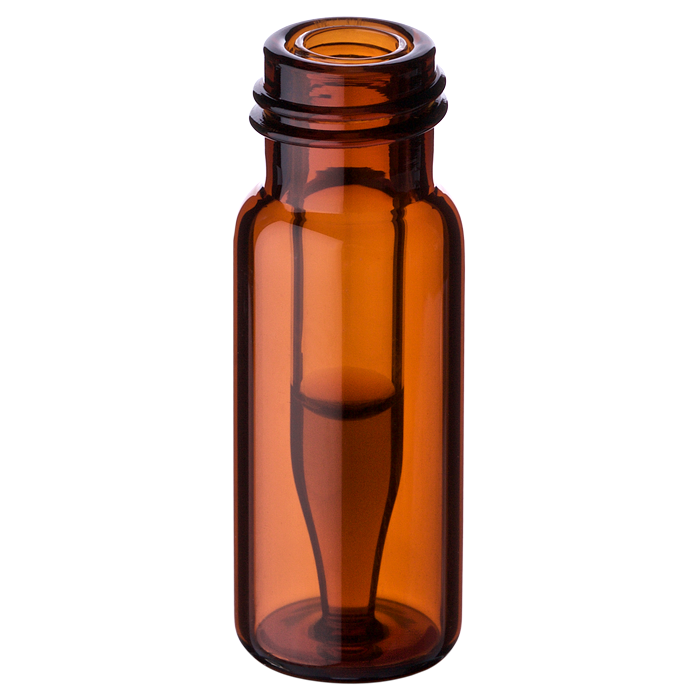
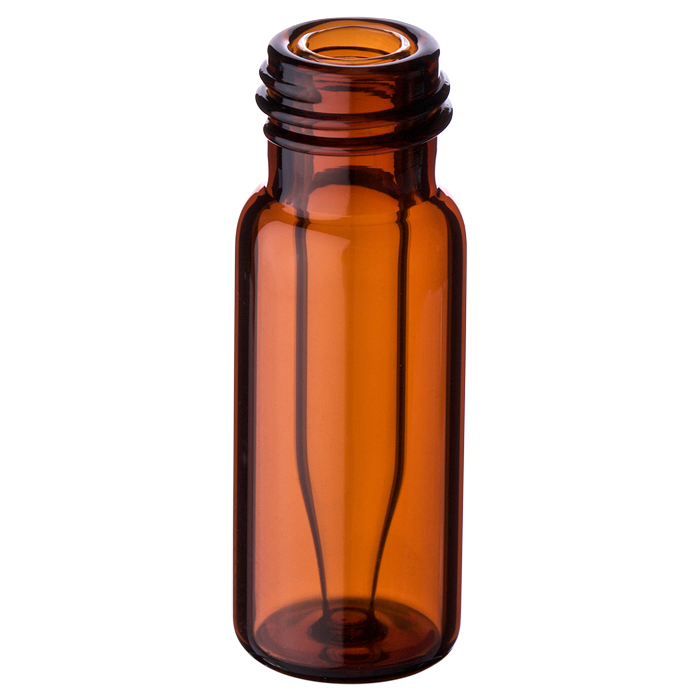
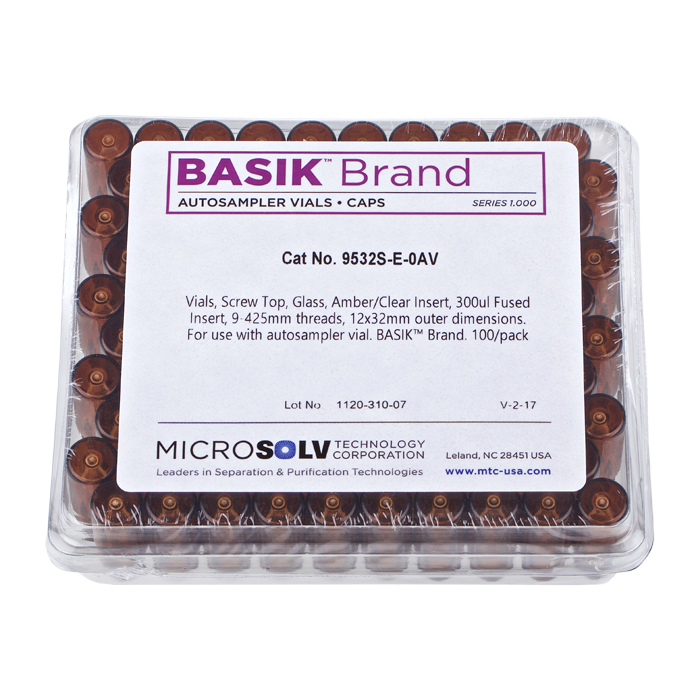
Vials, Screw Top, Glass. Amber / Clear Insert, 300ul Fused Insert, 9-425mm threads, 12x32mm outer dimensions. For use as an autosampler vial. BASIK Brand. 100/PK.
Additional Information:
The 9532S‑E‑0AV BASIK™ Amber Fused Insert Autosampler Vial is a cost‑effective, low‑volume vial designed for laboratories that require light protection and the simplicity of a bottom‑fused insert, without the added cost of premium surface‑treated or reduced‑surface‑activity chemistries.
The amber vial body is manufactured from first hydrolytic, Class A borosilicate glass and provides low‑actinic protection for light‑sensitive compounds. The 300 µL fused insert, also made from high‑quality borosilicate glass, is fused directly to the bottom of the vial and features a wide‑bottom geometry that helps minimize bubble formation during rapid manual filling or automated liquid handling.
This design offers reliable performance for routine workflows while maintaining one of the lowest price points available for fused‑insert autosampler vials.
Key Features
Economical Amber Borosilicate Glass Construction
First hydrolytic, Class A borosilicate glass
Amberized vial for light‑sensitive analytes
Clear fused insert for visibility during sampling
Bottom‑Fused Insert Design
Insert fused directly to the vial bottom
Nominal volume: 300 µL
Wide‑bottom insert helps reduce bubble formation
Suitable for rapid filling and automation
Autosampler Compatibility
Standard 9‑425 screw‑cap interface
12 × 32 mm dimensions compatible with common autosampler trays
Designed for routine, non‑critical analytical workflows
Budget‑Focused Value
Most economical amber fused‑insert vial
Ideal for cost‑controlled laboratories
Reliable alternative when premium fused‑insert designs are not required
Why Choose BASIK™ Amber Fused Insert Vials?
BASIK™ amber fused‑insert vials are selected when laboratories need:
Light protection for photosensitive samples
A low‑cost fused‑insert format
Reduced bubble formation during quick filling
Acceptable performance for routine HPLC and LC methods
These vials are especially well suited for teaching labs, screening workflows, and high‑volume routine analysis where economy is a priority.
Typical Applications
Routine HPLC autosampling
Automated liquid handling
Light‑sensitive compounds
Screening and high‑throughput workflows
Budget‑conscious laboratory operations