
Date: 7-JULY-2012 Last Updated: 15-AUGUST-2026
Overview
It is not uncommon for laboratories to observe different chromatographic results when the same HPLC method is transferred between instruments. Even when using:
- The same HPLC column
- The same mobile phases
- The same standards
- The same operating conditions
differences in instrument design can produce noticeable changes in chromatographic performance.
One of the most common causes of these differences is Extra Column Volume (ECV), sometimes referred to as system volume or extra-column dispersion.
What Is Extra Column Volume?
Extra Column Volume refers to the internal volume within the chromatographic flow path that exists outside of the analytical column.
Sources of ECV may include:
- Injector flow paths
- Connecting tubing
- Fittings and unions
- Detector flow cells
- Valve assemblies
- System plumbing
Although these volumes may appear small, they can have a significant influence on chromatographic performance, particularly when using modern high-efficiency columns.
How ECV Affects Chromatography
As analytes move through the system, additional volume outside the column can contribute to band broadening before and after chromatographic separation.
Potential effects include:
- Broader peaks
- Reduced peak height
- Lower efficiency
- Reduced resolution
- Changes in chromatographic appearance
- Apparent retention time differences
The impact becomes more pronounced as peak widths become narrower.
Why Instrument-to-Instrument Differences Occur
Different HPLC systems are not built with identical flow-path volumes.
Variations may include:
- Tubing length
- Tubing internal diameter
- Detector cell design
- Injector configuration
- Internal plumbing geometry
As a result, two instruments running the same method may produce chromatograms that look noticeably different despite using identical columns and operating conditions.
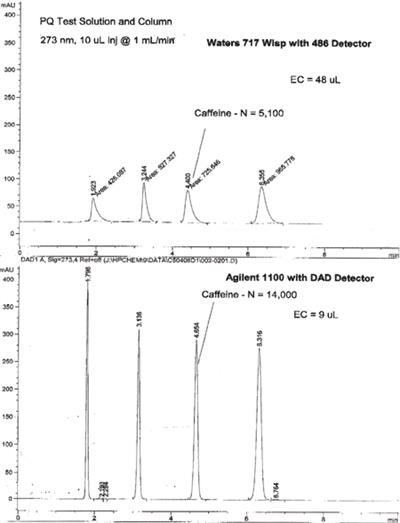
The image is most effective immediately after the discussion of instrument-to-instrument differences because it visually demonstrates how Extra Column Volume can affect peak shape, efficiency, and resolution when the same method is run on different systems.
Impact on Modern HPLC Columns
The influence of ECV becomes increasingly important when using:
- Small-particle columns
- Superficially porous particle columns
- UHPLC columns
- High-efficiency analytical columns
These columns produce narrow peaks and high efficiencies, making them more sensitive to system dispersion effects.
In some cases, instrument dispersion may contribute more to peak broadening than the column itself.
Common Sources of Excess Dispersion
Tubing
Oversized tubing diameter or excessive tubing length can increase system volume and contribute to peak broadening.
Detector Flow Cells
Large-volume detector flow cells may degrade efficiency by increasing post-column dispersion.
Fittings and Connections
Poorly seated fittings or improperly cut tubing may create dead volume that negatively affects peak shape.
Aging Components
Worn or damaged system components can introduce additional dispersion and reduce overall performance.
Minimizing Extra Column Volume
To reduce ECV effects:
- Use appropriately sized tubing.
- Minimize unnecessary tubing lengths.
- Verify proper fitting installation.
- Inspect tubing cuts and connections.
- Use detector flow cells appropriate for the application.
- Regularly maintain chromatographic systems.
Careful optimization of system plumbing can substantially improve chromatographic performance.
Measuring System Performance
Monitoring system dispersion can help laboratories:
- Compare instrument performance
- Track changes over time
- Evaluate method transfer success
- Support qualification programs
- Troubleshoot resolution issues
Qualification procedures can help establish baseline performance expectations and identify changes resulting from system modifications or component replacement.
Key Takeaways
- Extra Column Volume exists outside the analytical column.
- Different HPLC instruments can produce different chromatographic results because of varying system volumes.
- ECV contributes to peak broadening and reduced resolution.
- Modern high-efficiency columns are particularly sensitive to system dispersion.
- Tubing, fittings, injectors, and detector flow cells are common contributors to ECV.
- Proper system optimization can significantly improve chromatographic performance.
Additional Resources
For qualification standards, system performance evaluation tools, dispersion assessment guidance, and validation support materials, view: