
Date: 7-MAY-2012 Last Updated: 19-AUGUST-2026
Introduction
The ability to retain and separate highly polar compounds is one of the primary advantages of HILIC chromatography. In many cases, compounds such as carbohydrates, metabolites, nucleobases, and other polar analytes exhibit little retention in conventional reversed phase methods.
This study evaluates the chromatographic efficiency of the Cogent™ Diamond Hydride™ column under HILIC conditions using glucose, sorbitol, and uracil as model analytes. Efficiency was measured across a range of flow rates to evaluate column performance and retention behavior.
Study Overview
Two separate experiments were conducted to evaluate column efficiency.
Figure A
Glucose and sorbitol were analyzed on a:
- Cogent™ Diamond Hydride™ Column
- 2.1 × 150 mm
- 4 µm particles
Column efficiency was evaluated by plotting:
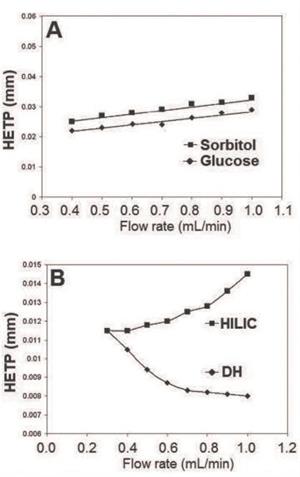
Flow Rate vs. HETP (Height Equivalent to a Theoretical Plate)
Results showed that increasing the flow rate by approximately 2.5-fold resulted in only a modest reduction in column efficiency, demonstrating robust performance across a broad operating range.
Figure B
Uracil was analyzed using:
- Cogent™ Diamond Hydride™ Column
- A commercially available HILIC column of comparable dimensions and particle size
Efficiency was compared over a range of flow rates.
The results demonstrated that the Cogent™ Diamond Hydride™ column maintained excellent efficiency as flow rates increased, while the comparison HILIC column exhibited a significant reduction in efficiency over the same operating range.
Chromatographic Performance
The study indicates that Cogent™ Diamond Hydride™ columns can maintain strong efficiency across a wide range of operating conditions commonly used in HILIC methods.
Observed benefits include:
- Strong retention of polar compounds
- Stable efficiency over changing flow rates
- Excellent suitability for LC-MS applications
- Reproducible chromatographic performance
- Effective separation of challenging analytes
These characteristics can be valuable for laboratories developing methods for carbohydrates, metabolites, and other highly polar compounds.
Figures:
A. Sorbitol, Glucose. On a Diamond Hydride Column
B. Uracil. DH and HILIC Column Comparison
Columns:
-- Figure A: Cogent Diamond Hydride™, 4μm, 100Å
-- Figure B: Cogent Diamond Hydride™, 4μm, 100Å
Catalog Nos.:
-- Figure A: 70000-15P-2
-- Figure B: 70000-15P
Dimensions:
-- Figure A: 2.1 x 150mm
-- Figure B: 4.6 x 150mm
Mobile Phase:
-- A: DI Water / 0.1% Formic Acid
-- B: Acetonitrile / 0.1% Formic Acid
Flow rate: Variable, See Charts
Detection: UV (Uracil) and LCMS (Sorbitol, Glucose)
Injection vol.: 10μL
Notes: Charts and Methods are adapted from “Analysis of Hydrophilic Metabolites in Physiological Fluids by HPLC-MS using a Silica Hydride-Based Stationary Phase”. J.J. Pesek, M.T. Matyska, J.A. Loo, S.M. Fischer, T.R. Sana, J. Sep. Sci., 32 (2009) 2200-2208.
