
Overview
Achieving a proper crimp seal is essential for maintaining sample integrity in HPLC, GC, Headspace GC, and other analytical applications. An improperly sealed vial can result in sample evaporation, contamination, pressure loss, inconsistent injections, and unreliable analytical results.
One of the simplest and most effective ways to verify a proper seal is to test whether the crimp cap can rotate on the vial after crimping.
Performing a Cap Rotation Test
After crimping the vial:
- Hold the vial firmly in one hand.
- Grasp the crimp cap with the other hand.
- Attempt to rotate the cap around the vial finish.
Properly Crimped Cap
If the cap remains fixed and does not rotate, the seal is generally considered acceptable. A properly crimped cap should maintain sufficient compression between the vial finish, septum, and aluminum cap to prevent movement.
Improperly Crimped Cap
If the cap rotates, even slightly:
- The seal may be inadequate.
- Solvent evaporation may occur.
- Sample integrity may be compromised.
- Injection reproducibility may be affected.
In this situation, the vial should be re-capped using a properly adjusted crimping tool.
Common Causes of Poor Crimp Seals
Several factors can contribute to an inadequate seal:
Under-Crimping
When insufficient crimp force is applied:
- The cap may rotate.
- The septum may not be adequately compressed.
- Leakage may occur.
Over-Crimping
Excessive crimp force can also create problems:
- Septa distortion
- Vial finish damage
- Difficult needle penetration
- Reduced septa performance
Crimper Misadjustment
Over time, crimping tools may require adjustment or calibration to maintain consistent sealing performance. Regular inspection and adjustment help ensure reliable results.
Visual Inspection of Crimp Quality
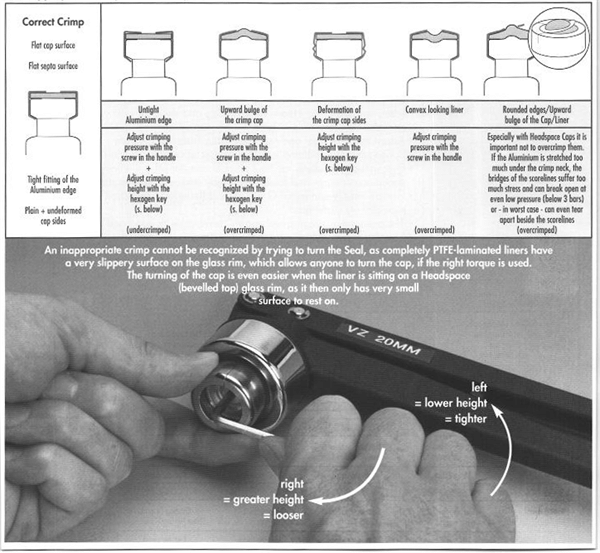
In addition to performing the rotation test, inspect the crimped cap for signs of improper sealing.
Examples of Improperly Crimped Caps
Why Proper Crimping Matters
A properly sealed vial helps:
- Prevent evaporation of volatile samples
- Maintain sample concentration
- Protect against contamination
- Improve injection reproducibility
- Support accurate analytical results
- Preserve headspace integrity when applicable
Even small sealing problems can affect chromatographic performance and data quality.
Best Practices
To maintain consistent sealing performance:
- Verify crimper adjustment regularly.
- Replace worn crimping components when necessary.
- Perform a cap rotation test after crimping.
- Visually inspect caps before analysis.
- Use caps, septa, and vials designed to work together.
Following these practices can help reduce sample handling issues and improve analytical reliability.
Key Takeaways
- A properly crimped cap should not rotate on the vial.
- Cap rotation is a simple indicator of an inadequate seal.
- Under-crimping can lead to evaporation, leakage, and injection problems.
- Crimping tools should be adjusted and maintained regularly.
- Visual inspection and cap rotation testing help verify seal quality.
- Proper seals are essential for reliable analytical results.