Date: 15-MAY-2013 Last Updated: 5-SEPTEMBER-2026
Introduction
Retention time is one of the most commonly reported values in chromatography, but it does not tell the complete story about analyte retention. Every compound must travel through the column with the mobile phase before it can be detected, meaning a portion of its retention time is simply due to transit through the chromatographic system.
To better characterize chromatographic behavior, analysts often use two important parameters:
- Hold-Up Time (tM)
- Adjusted Retention Time (tR')
These values provide a more meaningful assessment of analyte retention and stationary phase interactions than retention time alone.
What Is Hold-Up Time?
Hold-up time (tM), also known as dead time, is the time required for a non-retained compound to travel through the column and reach the detector.
A non-retained compound:
- Does not significantly interact with the stationary phase
- Travels at approximately the same rate as the mobile phase
- Represents the minimum time required for a substance to pass through the column
Hold-up time serves as a reference point for evaluating chromatographic retention.
Why Hold-Up Time Is Important
Every analyte spends part of its time simply moving through the column with the mobile phase.
Therefore, observed retention time consists of:
- Mobile phase transit time
- Stationary phase interaction time
Hold-up time accounts for the mobile phase transit component and allows chromatographers to determine how much retention is actually caused by chromatographic interactions.
What Is Adjusted Retention Time?
Adjusted retention time removes the contribution of hold-up time from the observed retention time. This value represents the time attributable solely to interaction between the analyte and the stationary phase.
The adjusted retention time is calculated using: tR' = tR − tM
Where:
- tR' = Adjusted retention time
- tR = Observed retention time
- tM = Hold-up time
Why Adjusted Retention Time Is Useful
Adjusted retention time provides a more accurate representation of analyte retention because it eliminates the unavoidable transit time through the system.
Benefits include:
- Improved comparison of analyte retention
- Better understanding of stationary phase interactions
- More meaningful retention calculations
- Improved method development evaluations
- More accurate capacity factor calculations
For this reason, adjusted retention time is frequently used in chromatographic theory and method optimization.
Interpreting Hold-Up Time and Retention
A useful rule of thumb is: If the analyte retention time equals the hold-up time, the compound is essentially unretained.
In this situation:
- The analyte travels with the mobile phase.
- Little or no stationary phase interaction occurs.
- Chromatographic retention is negligible.
Compounds exhibiting significant retention will always have retention times greater than the hold-up time.
Chromatographic Illustration
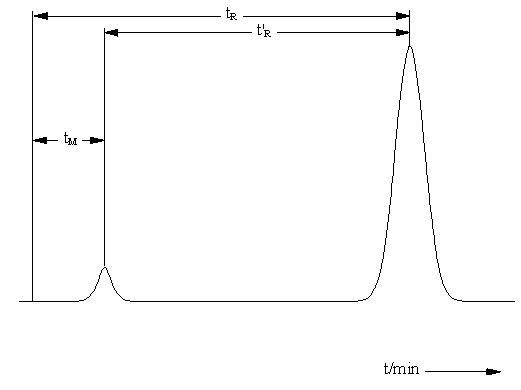
Chromatogram illustrating hold-up time (tM) and analyte retention time (tR). The difference between these values represents the adjusted retention time (tR').
Applications in HPLC Method Development
Hold-up time and adjusted retention time are commonly used for:
- Retention analysis
- Capacity factor calculations
- Method development
- Column comparison studies
- Selectivity evaluation
- Chromatographic modeling
These parameters help chromatographers assess how effectively the stationary phase retains a particular analyte.
Relationship to Capacity Factor
Adjusted retention time is also used to calculate the retention factor (capacity factor), one of the most important parameters in chromatography. Because capacity factor normalizes analyte retention relative to hold-up time, it often provides a more meaningful comparison than retention time alone.
Conclusion
Hold-up time (tM) represents the minimum time required for a non-retained compound to travel through a chromatographic column, while adjusted retention time (tR') measures only the retention attributable to interactions with the stationary phase. Together, these parameters provide a deeper understanding of chromatographic behavior and serve as important tools in HPLC method development, troubleshooting, and performance evaluation.