
Peonidin 3 Glucoside Analyzed by LC-MS - AppNote
February 15, 2014
/
/
/
Date: 15-FEBRUARY-2014 Last Updated: 14-AUGUST-2026
LC-MS method for Anthocyanin- Fruit or Vegetable ExtractsCogent™ Phenyl Hydride HPLC Column Catalog Numbers, Column Specifications, Available Dimensions, and Ordering Information
In this analysis, the presence of Peonidin-3-O–Glucoside was confirmed in two out of four extracts. The peaks were symmetrical and retained beyond the dead volume.
Due to the MS detection and comparison of the retention time, it was possible to find the peak for Peonidin-3-O-Glucoside among many peaks with similar m/z values present in the A1 extract. The method after validation can be used for quality control of commercial fruit extracts as well in studies of bioactivities of this important class of compounds.
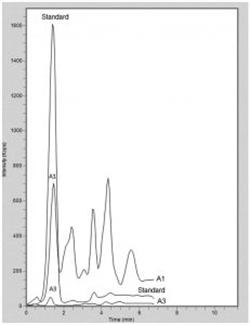
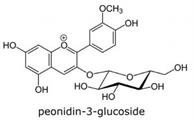
Peak: Peonidin 3-O-glucoside 463 m/z [M+]
Method ConditionsColumn: Cogent Phenyl Hydride™, 4 μm, 100 Å
Catalog No.: 69020-05P-2
Dimensions: 2.1 x 50 mm
Mobile Phase:
-- A: DI Water / 0.1% Formic Acid (v/v)
-- B: Acetonitrile / 0.1% Formic Acid (v/v)
Gradient:
| Time (minutes) | %B |
|---|---|
| 0 | 15 |
| 4 | 80 |
| 6 | 80 |
| 7 | 15 |
Post Time: 3 minutes
Injection vol.: 1 μL
Flow rate: 0.4 mL / minute
Detection: ESI – POS - Perkin Elmer, Flexar SQ 300 Mass Spectrometer
Sample Preparation: Four proprietary fruit or vegetable extracts were analyzed. Samples were marked A1 to A4.
t 0 : 0.4 minutes
Note: Anthocyanins are plant pigments and have recently been used as natural colorants in food products instead of synthetic dyes used in the food industry, which have been suspected to cause adverse neurological effects. The rapidly growing food and beverage market demands more and more of plant pigments. Also the main secondary metabolites in black rice are Anthocyanins, mainly Cyanidin-3-Oglucoside and Peonidin-3-O-Glucoside.
