Overview
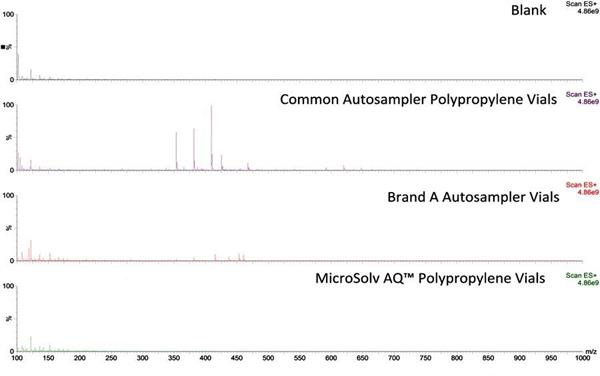
In LC-MS applications, every component that comes into contact with a sample has the potential to influence analytical results. While many laboratories focus on mobile phases, columns, and instrumentation, sample vials can also be a source of unwanted background signals.
Polypropylene vials are often selected when analytes are susceptible to adsorption on glass surfaces. However, not all polypropylene vials are manufactured to the same standards, and differences in raw materials and manufacturing processes can affect chromatographic and mass spectrometric performance.
Why Plastic Vial Purity Matters
Many conventional polypropylene vials are produced using additives that assist in manufacturing and processing.
Examples may include:
- Mold-release agents
- Clarifying additives
- Processing aids
- Stabilizing compounds
Under certain conditions, trace amounts of these materials may be extracted into analytical samples, particularly when organic solvents are present.
Potential effects include:
- Background peaks
- Increased chemical noise
- Unwanted mass spectral signals
- Reduced confidence in trace-level analyses
For LC-MS workflows, minimizing these sources of contamination is particularly important.
AQ™ LC-MS Compatible Polypropylene Vials
AQ™ LC-MS compatible polypropylene vials are manufactured using a specially selected polypropylene formulation designed to minimize extractable contaminants. The manufacturing approach focuses on producing vials suitable for sensitive analytical applications where background cleanliness is important.
Benefits may include:
- Reduced background signals
- Lower extractable content
- Consistent analytical performance
- Improved confidence in trace-level measurements
These characteristics can be particularly valuable in LC-MS methods involving low-concentration analytes.
Advantages in LC-MS Applications
Because mass spectrometry is highly sensitive, even trace contaminants may become visible during analysis.
Low-extractable polypropylene vials can help reduce:
- Ghost peaks
- Unexpected signals
- Chemical background interference
- Sample contamination risks
This contributes to cleaner chromatograms and improved interpretation of analytical data.
Solvent Compatibility
Polypropylene vials are commonly used with:
- Aqueous samples
- Organic solvent mixtures
- LC-MS mobile phases
- High-organic sample preparations
Their compatibility with a wide range of analytical solvents makes them useful for many chromatography workflows.
Applications
AQ™ polypropylene vials are particularly useful for:
- LC-MS analysis
- Trace-level determinations
- Peptide analysis
- Protein analysis
- Biological sample preparation
- Pharmaceutical applications
- Research laboratories
These applications often benefit from lower background contributions and reduced sample-container interactions.
Product Features
Available options may include:
- Screw-top configurations
- Snap-top configurations
- Flat-bottom designs
- Write-on identification patches
These features support compatibility with a variety of autosampler platforms and laboratory workflows.
Key Takeaways
- Polypropylene vial quality can affect LC-MS results.
- Conventional plastic vials may contain extractable manufacturing additives.
- AQ™ LC-MS compatible polypropylene vials are designed to minimize extractable contaminants.
- Lower background interference can improve analytical confidence.
- These vials are well suited for trace-level, biological, pharmaceutical, and LC-MS applications.
- Consistent vial quality helps support reproducible analytical performance.