Date: 31-DECEMBER-2014 Last Updated: 5-SEPTEMBER-2026
Introduction
When developing or transferring gradient HPLC methods, chromatographers often focus on mobile phase composition, flow rate, column selection, and temperature. However, one system parameter that can substantially affect retention behavior is dwell volume.
Differences in dwell volume can cause the same gradient method to produce different retention times on different instruments, even when all other method parameters remain unchanged. Understanding dwell volume is therefore essential for successful method development, troubleshooting, and method transfer.
What Is Dwell Volume?
Dwell volume is the volume between the point where mobile phase solvents are mixed and the inlet of the HPLC column. Because the mixed solvents must travel through this volume before reaching the column, there is always a delay between the programmed start of a gradient and the moment the gradient actually reaches the stationary phase.
This delay affects:
- Retention times
- Gradient timing
- Peak spacing
- Method transfer
- Resolution
- Selectivity
Example Gradient Program
Consider the following gradient:
| Time (min) | % B Solvent |
|---|---|
| 0 | 20 |
| 9 | 60 |
| 10 | 20 |
Example gradient method showing programmed changes in %B over time.
The gradient appears to begin immediately at the start of the run. In practice, however, the column does not experience the gradient until the mixed solvent reaches the column inlet. The time required for this to occur depends on the system dwell volume.
Why Dwell Volume Matters
A larger dwell volume increases the delay before the gradient reaches the column. A smaller dwell volume reduces this delay.
As a result:
- Higher dwell volume systems typically show later retention times.
- Lower dwell volume systems typically show earlier retention times.
- Peak spacing may change.
- Apparent selectivity can be altered.
- Resolution may increase or decrease.
These differences can be substantial when transferring methods between instrument platforms.
Effect on Analyte Retention
In gradient chromatography, retention is directly influenced by when the mobile phase composition changes at the column. If one system delivers the gradient later than another, analytes may spend more time under weaker mobile phase conditions, increasing retention.
Conversely, a lower dwell volume may expose analytes to stronger mobile phase conditions earlier, reducing retention times. This is one of the most common reasons two HPLC systems produce different chromatograms while using the same programmed gradient.
Comparison of High and Low Dwell Volume Systems
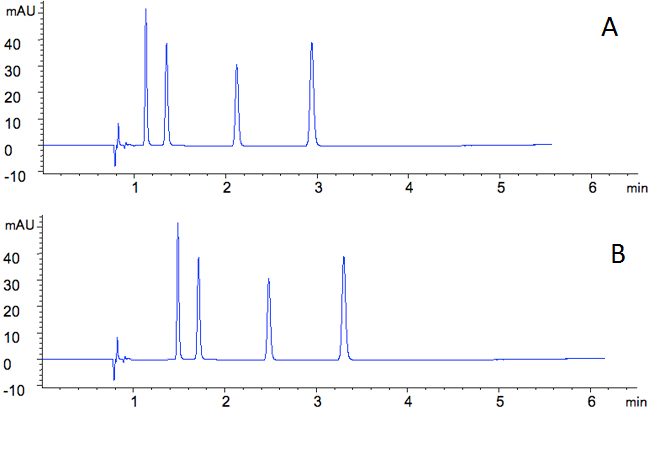
Comparison of chromatographic retention observed on low dwell volume and high dwell volume systems using the same gradient method. The chromatograms demonstrate how dwell volume differences can shift analyte retention while the programmed gradient remains unchanged.
High Pressure Versus Low Pressure Mixing Systems
One of the largest contributors to dwell volume is the instrument mixing design.
HPLC systems generally employ either:
- Low-pressure mixing
- High-pressure mixing
The location where solvents are mixed determines how much volume exists between the mixing point and the column.
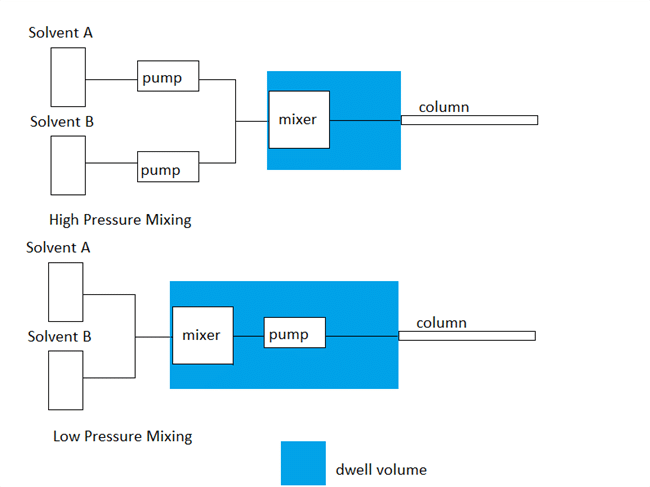
Simplified comparison of solvent flow paths and dwell volume characteristics in low-pressure and high-pressure mixing HPLC systems.
Low Pressure Mixing Systems
In low-pressure mixing systems, solvents are combined before entering the pump.
Because the mixed mobile phase travels through a larger portion of the fluid path before reaching the column, these systems often exhibit larger dwell volumes.
Characteristics may include:
- Larger dwell volume
- Longer gradient delay
- Later apparent retention times
- Greater impact on gradient method transfer
High Pressure Mixing Systems
In high-pressure mixing systems, individual pumps deliver each solvent separately and mixing occurs closer to the column.
These systems often exhibit:
- Smaller dwell volume
- Shorter gradient delay
- Earlier retention times
- Easier adaptation to some high-speed gradient methods
Dwell Volume and Method Transfer
Dwell volume differences are among the most common causes of method transfer problems between instruments.
Potential observations include:
- Unexpected retention shifts
- Different peak spacing
- Changes in selectivity
- Altered resolution
- Different system suitability results
When transferring methods, dwell volume should be considered alongside:
- Column dimensions
- Flow rate
- Detector volume
- Tubing dimensions
- System plumbing
Practical Considerations
When evaluating gradient methods:
- Determine the dwell volume of each system.
- Compare instrument mixing designs.
- Consider dwell volume during method transfer.
- Investigate dwell volume differences when retention shifts occur.
- Evaluate whether gradient timing adjustments are necessary.
Understanding dwell volume often resolves chromatographic differences that might otherwise be incorrectly attributed to the column, mobile phase, or instrument performance.
Conclusion
Dwell volume is the volume between the solvent mixing point and the HPLC column and plays a critical role in gradient chromatography. Differences in dwell volume can significantly affect retention times, selectivity, and method transfer success. Because high-pressure and low-pressure mixing systems typically have different dwell volumes, understanding this parameter is essential when troubleshooting gradient methods or transferring methods between instruments.