Overview
When troubleshooting missed injections, inconsistent peak areas, or sample aspiration failures, many laboratories focus on the autosampler, syringe, needle, or injection settings. However, autosampler vials themselves can sometimes contribute to these problems.
While external vial dimensions are important for proper fit within autosampler trays and racks, internal vial geometry can be equally important to injection accuracy and reproducibility.
Modern autosamplers often rely on precise knowledge of the vial's internal dimensions to position the needle correctly for sample withdrawal.
Why Vial Dimensions Matter
Most instrument manufacturers publish specifications for:
- Overall vial height
- Outer diameter
- Neck dimensions
- Shoulder profile
These external dimensions ensure that vials fit properly into the autosampler and move through the injection sequence without mechanical interference.
However, external dimensions alone do not guarantee reliable sample aspiration. The internal dimensions of the vial also play a critical role in determining where the autosampler needle travels during sample pickup.
Autosampler Needle Positioning
Many modern autosamplers use bottom-sensing or vial-learning routines to determine the internal position of the vial bottom.
These systems are designed to:
- Prevent needle damage
- Optimize sample draw depth
- Improve injection reproducibility
- Minimize sample carryover
- Maximize recovery from low sample volumes
Accurate needle positioning depends on consistent internal vial dimensions. If the internal bottom location varies significantly from vial to vial, the autosampler may not sample consistently throughout a sequence.
Problems Caused by Inconsistent Internal Geometry
Vials manufactured only to meet external specifications may exhibit significant variation in internal dimensions.
Examples include:
- Uneven bottom profiles
- Excessive internal curvature
- Convex vial bottoms
- Variable internal bottom heights
These variations can lead to:
- Missed injections
- Inconsistent injection volumes
- Reduced sample recovery
- Poor reproducibility
- Needle-positioning errors
- Potential needle damage in older systems
The issue becomes more significant when working with low sample volumes or highly sensitive analytical methods.
Critical Internal Vial Dimensions
Several dimensions contribute to autosampler performance, but internal bottom height is often among the most important.
Overall Height
Ensures proper vial positioning within trays and racks.
Outer Diameter
Provides compatibility with autosampler vial holders.
Internal Opening Diameter
Impacts needle entry and centering.
Internal Bottom Height
Determines the distance between the vial opening and the sample reservoir at the bottom of the vial. This dimension directly affects needle placement and sample aspiration consistency.
Consistency Across a Sample Sequence
For laboratories running large sequences, consistency between vials is critical.
If one vial has a significantly different internal bottom height than another, the autosampler may:
- Draw sample at different depths
- Aspirate different sample volumes
- Miss the liquid entirely
- Produce variable results
This can create unnecessary troubleshooting challenges and affect data quality.
RSA™ and AQ™ Vial Design Considerations
RSA™ and AQ™ autosampler vials and inserts are manufactured with attention to both external and internal dimensional consistency.
Quality-control programs verify characteristics including:
- Overall dimensions
- Internal geometry
- Bottom-height consistency
- Functional compatibility
Consistent internal dimensions can help support reliable operation in autosamplers that utilize bottom-sensing and needle-positioning routines.
Benefits of Internal Dimensional Consistency
Vials manufactured to tight internal tolerances can help:
- Improve injection reproducibility
- Reduce missed injections
- Support low-volume sampling
- Improve sequence reliability
- Protect autosampler needles
- Reduce troubleshooting time
These benefits are particularly important in regulated laboratories and high-throughput environments where consistency is essential.
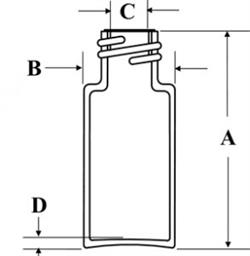
| Dimension | Description |
|---|---|
| A | Overall Height |
| B | Outer Diameter |
| C | Internal Opening Diameter |
| D ** | Internal Bottom Height (critical for needle positioning) |
Key Takeaways
- Autosampler vial selection involves more than external dimensions.
- Internal bottom geometry can influence injection performance.
- Inconsistent vial bottoms may contribute to missed injections and variable sample uptake.
- Modern autosamplers often rely on accurate internal dimensional consistency.
- Internal bottom height is a critical parameter for needle positioning.
- Consistent vial manufacturing can improve reproducibility and system reliability.