
Introduction
Ammonium acetate is one of the most commonly used volatile buffers in HPLC, UHPLC, and LC-MS applications. It is frequently specified in chromatographic methods either as a percentage concentration or as a molarity value.
This can create confusion when one procedure specifies: 0.1% (w/v) ammonium acetate while another method requires: mM ammonium acetate
Because both concentration expressions describe the same solution differently, chromatographers must often convert between the two units during method transfer, validation, or mobile phase preparation.
What Does % (w/v) Mean?
The abbreviation w/v means: Weight per Volume and is commonly used when a solid material is dissolved in a liquid.
Specifically:
0.1% (w/v) means:
- 0.1 grams of material
- dissolved and diluted to 100 mL total volume
For ammonium acetate, this corresponds to:
- 1.0 gram per liter (1000 mL)
Why Convert to mM?
Many chromatographic methods, especially HILIC and LC-MS procedures, specify buffer concentration using:
- Molarity (M)
- Millimolarity (mM)
This is useful because chromatographic behavior is often related to the number of molecules present rather than the actual mass of buffer added.
Using molarity provides:
- Improved method transferability
- Easier comparison between buffers
- Better control of ionic strength
- Greater consistency between laboratories
Molecular Weight of Ammonium Acetate
To convert from % (w/v) to molarity, the molecular weight must be known. Ammonium Acetate Molecular Weight: 77.1 g/mol
Conversion Procedure
To convert a 0.1% (w/v) ammonium acetate solution:
Step 1
Convert the percentage concentration to grams per liter. 0.1% (w/v) equals: 1.0 g/L
Step 2
Convert grams to moles using the molecular weight.
Step 3
Express the concentration as moles per liter.
or
Step 4
Convert molarity to millimolarity.
Reference Calculation
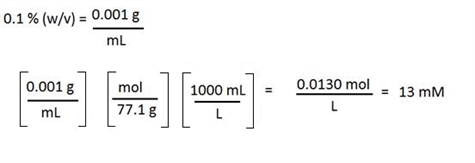
Final Result
0.1% (w/v) Ammonium Acetate = Approximately 13 mM
This value is often rounded appropriately based on laboratory SOP requirements.
Why This Matters for HPLC and LC-MS
Ammonium acetate concentration can significantly influence:
- Retention
- Selectivity
- Peak shape
- Ionization efficiency
- LC-MS sensitivity
- System reproducibility
Understanding concentration conversions helps ensure mobile phases are prepared correctly and consistently.
This is particularly important when:
- Transferring methods
- Comparing published procedures
- Validating methods
- Troubleshooting retention differences
Common Buffer Concentrations Used in Chromatography
Typical ammonium acetate concentrations include:
- 1 mM
- 5 mM
- 10 mM
- 13 mM (approximately 0.1% w/v)
- 20 mM
In LC-MS applications, lower concentrations are often preferred to minimize:
- Ion suppression
- Source contamination
- Maintenance requirements
Key Takeaways
- % (w/v) means weight of solute per final volume of solution.
- Ammonium acetate has a molecular weight of 77.1 g/mol.
- A 0.1% (w/v) ammonium acetate solution equals approximately 1.0 g/L.
- Converting 1.0 g/L to molarity yields approximately 0.013 M.
- 0.013 M corresponds to approximately 13 mM.
- Understanding these conversions improves method reproducibility and mobile phase preparation accuracy.