Date: 15-OCTOBER-2026 Last Updated: 15-OCTOBER-2026
IntroductionBisphenol A (BPA) degradation can produce a variety of structurally related phenolic compounds that present significant chromatographic challenges due to their similar chemical and UV spectral characteristics. This application demonstrates the separation of BPA along with representative degradation products and related phenolic compounds using a MICROSOLV® reversed-phase HPLC column, providing a practical solution for routine PDA-based monitoring and impurity profiling.
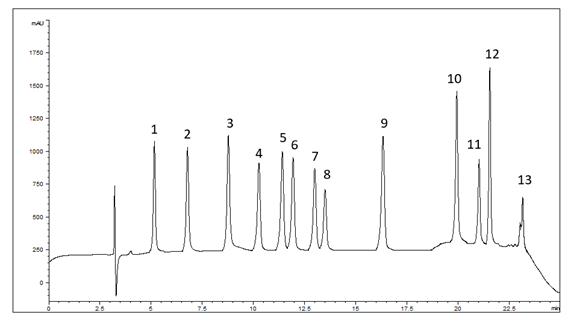
1. Hydroquinone, 2. Catechol, 3. 3-(3,4-Dihydroxyphenyl)acrylic acid (Caffeic acid), 4. p-Hydroxybenzaldehyde, 5. 4-Hydroxyacetophenone, 6. p-Coumaric acid, 7. 4-Hydroxy-3-methoxycinnamic acid (Ferulic acid), 8. 3,5-Dimethoxy-4-hydroxycinnamic acid (Sinapic acid), 9. 4,4'-Sulfonyldiphenol, 10. 4,4'-Methylenediphenol, 11. 4-Isopropylphenol, 12. Bisphenol A, 13. 4-(Prop-1-en-2-yl)phenol
Column:
Cogent Phenyl Hydride™, 4 μm, 100 Å
Catalog No.
:
69020-25P
Dimensions
: 4.6 x 250 mm
Mobile Phase
:
--
A: DI H2O +
0.1% formic acid
--
B: Acetonitrile
+
0.1% formic acid
Gradient
:
| Time (minutes) | %B |
|---|---|
| 0 | 15 |
| 15 | 35 |
| 20 | 65 |
| 21 | 15 |
Injection vol.
: 4 μL
Flow rate
: 1.0 mL/minute
Detection
: UV @ 210 nm
Sample Preparation
:
| Peak | Compound | Concentration (mg/mL) |
|---|---|---|
| 1 | Hydroquinone (HQ) | 1.46 |
| 2 | Catechol (CAT) | 1.3 |
| 3 | 3-(3,4-Dihydroxyphenyl)acrylic Acid (Caffeic Acid, CA) | 1.5 |
| 4 | p-Hydroxybenzaldehyde (HBA) | 1.25 |
| 5 | 4-Hydroxyacetophenone (HAP) | 1.5 |
| 6 | p-Coumaric Acid (PCA) | 1.3 |
| 7 | 4-Hydroxy-3-methoxycinnamic Acid (Ferulic Acid, FA) | 1.3 |
| 8 | 3,5-Dimethoxy-4-hydroxycinnamic Acid (Sinapic Acid, SA) | 1.2 |
| 9 | 4,4'-Sulfonyldiphenol (SDP) | 1.3 |
| 10 | 4,4'-Methylenediphenol (MDP) | 1.23 |
| 11 | 4-Isopropylphenol (iPrP) | 1.26 |
| 12 | Bisphenol A (BPA) | 1.49 |
| 13 | 4-(Prop-1-en-2-yl)phenol (IPP) | 1.28 |
Mixed Standard:
100 µL of each stock solution.
Notes: Bisphenol A (BPA) became one of the world's most widely used industrial chemicals because its structure helps produce strong, clear polycarbonate plastics and durable epoxy resins. Ironically, that same structure makes BPA interesting to scientists studying degradation, as small chemical changes can produce a variety of closely related phenolic compounds that are often difficult to distinguish analytically.