
Date: 03-August-2026 Last Updated: 03 -August-2026
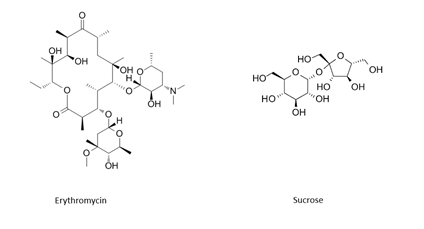
Erythromycin is a macrolide antibiotic used to treat a variety of bacterial infections, including respiratory tract infections, skin infections, and certain gastrointestinal infections. Sucrose is commonly used in erythromycin oral suspensions and pediatric formulations as a sweetening agent to improve taste and patient acceptance. This method enables the simultaneous analysis of both the active pharmaceutical ingredient and a common formulation excipient, making it useful for pharmaceutical quality control..
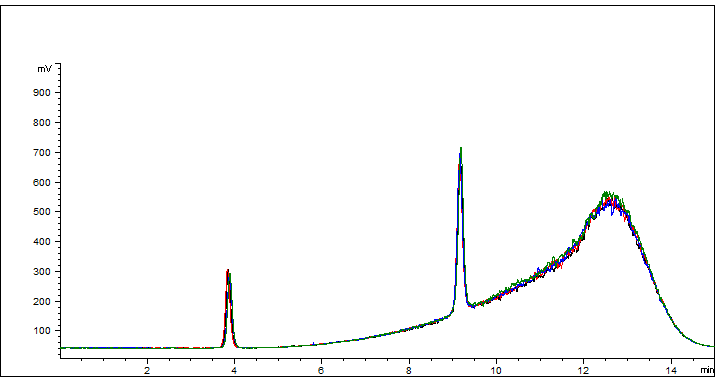
Below is a chromaotgram showing a 5 injection overlay.
Peaks:
1. Erythromycin
Method Conditions:
Column: Cogent Amide™, 4 μm, 100 Å
Catalog No.: 40036-15D
Dimensions: 4.6 x 150 mm
Mobile Phase:
B: Acetonitrile / 0.1% Triethylamine (TEA) (v/v)
Gradient:
| Time (minutes) | %B |
|---|---|
| 0 | 90 |
| 1 | 90 |
| 10 | 70 |
| 11 | 90 |
| 15 | END |
Flow Rate: 1.0 mL / minute
Detection: ELSD (Gain 8, Temp 50C, Nitrogen: 3.5lb)
Injection Volume: 2 uL
Sample Preparation: Separate stock solutions of erythromycin (2.25 mg/mL) and sucrose (3.5 mg/mL) were prepared. A working standard was prepared by mixing 200 µL of each stock solution with 600 µL of diluent (50:50 acetonitrile/DI water containing 0.1% TEA, v/v), resulting in final concentrations of 0.45 mg/mL erythromycin and 0.70 mg/mL sucrose.
Note: Erythromycin is a naturally derived antibiotic originally isolated from the bacterium Saccharopolyspora erythraea.