
Date: 31-JANUARY-2025 Last Updated: 14-AUGUST-2026
Overview
The quality of a tubing cut can have a significant impact on HPLC system performance. While tubing preparation is often overlooked during troubleshooting, damaged or poorly cut tubing can contribute to pressure changes, connection problems, and reduced chromatographic efficiency.
One common cause of tubing damage is the use of worn or dull cutting blades when preparing PEEK tubing.
How Dull Cutting Edges Affect PEEK Tubing
PEEK tubing is designed with precise internal and external dimensions to provide predictable flow characteristics throughout the chromatographic system.
As cutting blades wear, they become less capable of producing a clean, square cut. Instead of slicing cleanly through the tubing, the blade may compress and deform the tubing wall during the cutting process.
This can result in:
- Distorted tubing ends
- Reduced internal diameter
- Loss of tubing concentricity
- Uneven tubing faces
- Increased flow resistance
The degree of deformation becomes more significant as tubing diameters become smaller.
Impact on Chromatographic Performance
Changes in tubing geometry can create unexpected system behavior.
Potential consequences include:
- Increased backpressure
- Inconsistent pressure readings
- Reduced flow performance
- Altered chromatographic results
- Additional troubleshooting time
In some situations, a damaged tubing end may be mistaken for:
- Column blockage
- Fitting problems
- Pump issues
- Sample preparation problems
As a result, laboratories may spend considerable time investigating symptoms that are actually caused by poor tubing preparation.
Importance of Maintaining Concentricity
Concentricity refers to maintaining the proper relationship between the tubing inner diameter and outer diameter.
When a tubing cut compresses the tubing wall:
- The internal flow path may become distorted.
- Fluid velocity may change.
- Connection quality may be reduced.
- Flow characteristics may become less predictable.
Maintaining concentricity is especially important when working with small internal diameter tubing commonly used in HPLC, UHPLC, and LC-MS systems.
Example of New vs. Worn Cutting Edges
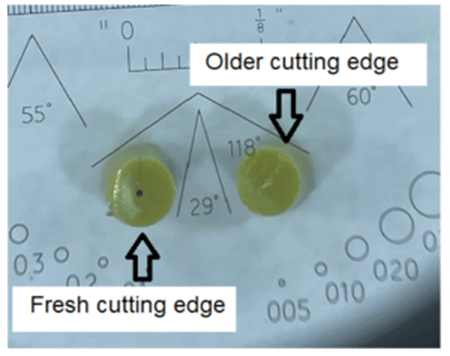
The image below illustrates the difference between tubing cut with a fresh cutting edge and tubing cut using a worn cutting edge.
The example shown uses:
- 0.007 in. (0.18 mm) ID PEEK tubing
- 1/16 in. (1.6 mm) OD tubing
New vs. Worn Cutting Edge Comparison
Best Practices for Tubing Preparation
To help maintain optimal system performance:
- Inspect cutting blades regularly.
- Replace worn blades when signs of deformation are observed.
- Verify tubing cuts are clean and square.
- Inspect tubing ends before installation.
- Use cutting tools designed specifically for chromatography tubing.
Routine maintenance of tubing preparation tools can help prevent unnecessary troubleshooting and improve overall system reliability.
Key Takeaways
- Dull cutting blades can deform PEEK tubing during preparation.
- Tubing deformation may alter pressure and flow characteristics.
- Loss of internal diameter and concentricity can affect chromatographic performance.
- Poor tubing cuts may mimic other HPLC system problems.
- Fresh cutting edges help ensure clean, square tubing cuts.
- Proper tubing preparation supports reliable chromatography and minimizes troubleshooting.