Overview
RSA-Pro X™ Autosampler Vials and Low Volume Glass Inserts are designed for applications that require exceptional hydrophobicity, low analyte adsorption, and superior hydrolytic stability. These products were developed to overcome many limitations associated with conventional silanized glass vials, especially when working with aqueous samples or analytes that are prone to surface interaction.
Background
Glass vial surfaces naturally contain silanol groups (Si-OH), which can interact with basic, polar, or surface-active compounds. These interactions may result in:
- Analyte loss due to adsorption
- Increased %RSD values
- Poor quantitative reproducibility
- Vial-to-vial variability
- Time-dependent degradation in analytical performance
Traditional silanized glass vials attempt to reduce these interactions through surface modification. However, silanization can be incomplete, may degrade over time, and often exhibits limited stability under aqueous conditions.
RSA-Pro X™ vials provide an alternative approach using RSA™ (Reduced Surface Activity) technology. The hydrophobic glass surface treatment maintains its performance even after exposure to:
- Aqueous solutions
- Freeze-thaw cycles
- Refrigerated storage
- Autoclaving procedures
Experimental Design
Objective
Evaluate the quantitative stability and reproducibility of RSA-Pro X™ vials compared with conventional silanized glass vials during extended exposure to aqueous conditions.
Analyte: Chlorhexidine Acetate 1 ppm in deionized water
Method Conditions:
Column: Cogent RP C18™, 5 μm, 100 Å (Cat. No. 68518-15P)Dimensions: 4.6 × 150 mm
Mobile Phase: 55:45 acetonitrile / buffer (v/v)
Buffer: 0.690 g sodium dihydrogen phosphate, 14.0 g sodium perchlorate, 0.340 mL phosphoric acid (50%) in 1 L DI water
Injection Volume: 10 μL
Flow Rate: 1.0 mL/min
Detection: UV at 260 nm
Sample Prep: 1 ppm chlorhexidine acetate in DI water, prepared in PPE bottle
Results Summary
-
24-Hour Exposure:
Minimal difference in %RSD between RSA-Pro X™ and silanized vials, indicating comparable short-term performance. -
72-Hour Exposure:
RSA-Pro X™ vials demonstrated:- Lower analyte loss over time
- Significantly improved reproducibility (%RSD)
- Superior surface stability in aqueous conditions
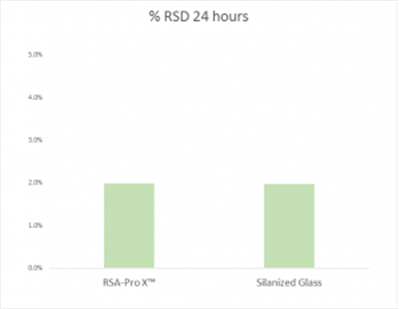
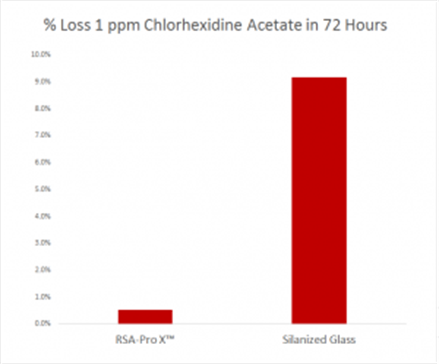

These results confirm that RSA-Pro X™ vials maintain surface integrity and analytical performance over extended periods, unlike conventional silanized vials which degrade in performance due to surface instability and incomplete silanol masking.
Conclusion
RSA-Pro X™ vials and inserts provide a reliable solution for applications involving:
- Aqueous sample matrices
- Hydrophilic or basic analytes
- Long-term sample storage
- High-sensitivity LC or LC-MS workflows
Their hydrophobic, hydrolytically stable surface ensures consistent quantitation, reduced analyte loss, and improved reproducibility—making them a superior alternative to traditional silanized glass.
Note: If you’ve experienced inconsistent surface coverage, loss of hydrophobicity, or performance degradation in silanized vials, RSA-Pro X™ technology offers a robust and validated upgrade.