
Introduction
Low-pressure unions, tees, and crosses are commonly used throughout chromatography systems, laboratory fluid handling assemblies, solvent delivery systems, and analytical instrumentation. While most users focus on the threaded ports used for tubing connections, some components include additional unthreaded holes that often raise questions.
These holes are not part of the fluid path and do not affect flow characteristics, pressure performance, or internal volume. Instead, they serve a practical mechanical purpose related to mounting and securing components within an instrument or laboratory setup.
What Are the Unthreaded Holes Used For?
The unthreaded holes were introduced to provide a convenient method for securing low-pressure unions, tees, and crosses to a stationary structure.
Common mounting locations include:
- Instrument panels
- Equipment frames
- Lattice structures
- Support brackets
- Fluid handling assemblies
- Laboratory racks
By securing the fitting body, tubing stress can be reduced while improving overall fluid path organization.
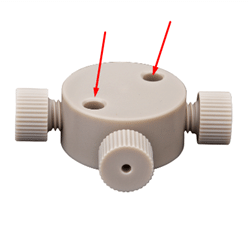
Example of a low-pressure union, tee, or cross showing the unthreaded mounting holes used for securing the fitting to an instrument frame, panel, or support structure.
Why Mounting Can Be Beneficial
In systems with multiple tubing runs, unsupported fittings may move when tubing is connected, disconnected, or under tension.
Proper mounting can help:
- Improve system organization
- Reduce strain on tubing connections
- Minimize movement of fittings
- Simplify maintenance activities
- Improve accessibility during instrument servicing
- Reduce the likelihood of accidental tubing damage
These benefits become increasingly important in complex laboratory and process fluid systems.
Do the Mounting Holes Affect Fluid Flow?
No.
The unthreaded holes are entirely external to the flow path and have no impact on:
- Flow rate
- Pressure performance
- Backpressure
- Internal volume
- Chromatographic efficiency
- Dead volume
Their purpose is strictly mechanical and related to installation or system organization.
Applications Where Mounting Holes Are Commonly Used
Mounting holes may be particularly useful in:
- Chromatography systems
- Solvent delivery assemblies
- Multi-line fluid distribution systems
- Sample handling systems
- Instrument OEM installations
- Laboratory automation equipment
In these environments, securing fluid-path components can improve overall system reliability and simplify maintenance.
Conclusion
The unthreaded holes found in some low-pressure unions, tees, and crosses are designed for mounting and securing the component to an instrument, panel, rack, or support structure. They do not participate in the fluid path and have no effect on chromatographic performance. Their primary purpose is to improve mechanical stability, reduce tubing stress, and support organized fluid-path management.