How High Injection Volume Impacts Column Performance in HILIC HPLC
When working in HILIC mode on Cogent TYPE‑C™ silica columns, injection volume plays a critical role in determining chromatographic performance. HILIC is exceptionally powerful for retaining hydrophilic and polar analytes, but its sample‑loading capacity behaves more like traditional Normal Phase rather than Reversed Phase (RP) chromatography. This means that high injection volumes can negatively influence separation quality.
This article explains why HILIC is more sensitive to injection volume and provides clear guidance for achieving optimal peak shape and retention.
Why HILIC Has Lower Loading Capacity Than RP
In HILIC, retention primarily relies on interactions between the analyte and a thin water layer on the silica hydride surface, along with partial partitioning into the high‑organic mobile phase. Because this mechanism is more delicate than RP hydrophobic retention:
- Column capacity is lower, similar to Normal Phase
- Excess sample volume can overwhelm the retention mechanism
- Peaks become broader, less symmetrical, and reduced in retention
As a result, the injection volume that works in RP often cannot be directly transferred to HILIC.
Recommended Maximum Injection Volume for Standard Columns
For standard 4.6 mm ID analytical Cogent TYPE‑C™ columns, the injection volume should ideally be kept:
Below 5 µL:
Injecting more than this increases the likelihood of:
- Efficiency loss
- Peak fronting or tailing
- Reduced resolution
- Poor reproducibility
Experimental Evidence: Injection Volume Study (1–10 µL)
A controlled study using a test solute in HILIC mode showed the progressive impact of increasing injection volume:
|
Injection Volume |
Chromatographic Result |
|---|---|
|
1 µL |
Sharp, symmetrical peak with ideal retention |
|
3–5 µL |
Slight broadening; performance acceptable but less optimal |
|
10 µL |
Significant tailing, reduced retention, and major distortion |
The study confirms that even modest increases in injection volume can cause measurable deterioration in peak quality.
Why High Volume Causes Peak Distortion
High injection volumes undermine peak quality in HILIC because they:
- Introduce too much aqueous plug into a high‑organic system
- Momentarily disrupt HILIC retention conditions
- Cause the analyte to partially elute during injection
- Broaden the analyte band before it interacts with the stationary phase
How to Achieve Sharp, Symmetrical Peaks in HILIC
✔ Keep injection volume as low as possible
Aim for 1–3 µL whenever feasible.
✔ Concentration matters
The total mass loaded is just as important as the volume. High concentration at low volume can still overload the column.
✔ Re‑optimize for HILIC rather than RP
Methods developed for RP conditions may require reduced injection volumes when converted to HILIC.
✔ Validate performance using a small‑volume injection baseline
Always establish a 1 µL benchmark run for comparison.
Conclusion
In HILIC mode, Cogent TYPE‑C™ columns deliver excellent retention for polar analytes—but only when injection volume is properly controlled. Exceeding 5 µL on a standard 4.6 mm ID column can lead to broad, asymmetric peaks and loss of retention. To ensure sharp peaks and reproducible separations, keep injection volumes low and tailor your method specifically for HILIC loading behavior.
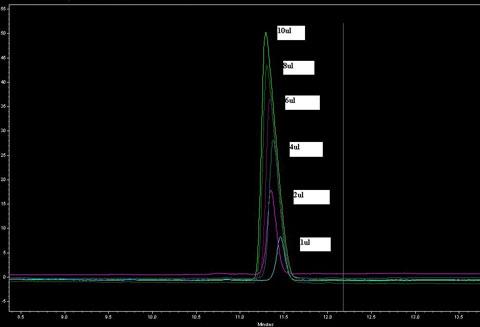
To get sharp, symmetrical peaks simply inject less amount when working in HILIC mode.