
Overview
Column efficiency is one of the most important factors affecting chromatographic resolution, sensitivity, and overall method performance. When analyzing polar compounds, HILIC has become a widely used chromatographic approach because it provides retention for analytes that may not be adequately retained in traditional reversed phase methods.
However, not all HILIC columns achieve retention through the same chromatographic processes.
Cogent™ TYPE-C™ columns, including Diamond Hydride™, perform HILIC separations through a unique silica hydride surface chemistry that differs from many conventional hydrophilic HILIC stationary phases.
These differences can influence:
- Column efficiency
- Mass transfer
- Retention reproducibility
- Equilibration behavior
- Overall chromatographic performance
Understanding HILIC Efficiency
Chromatographic efficiency is commonly measured using: HETP (Height Equivalent to a Theoretical Plate)
Lower HETP values generally indicate more efficient separations and sharper chromatographic peaks.
Efficiency is influenced by several factors including:
- Particle size
- Flow rate
- Mass transfer
- Mobile phase composition
- Retention mechanism
Because retention mechanisms differ among HILIC stationary phases, efficiency characteristics can also differ significantly.
Traditional HILIC Retention
Many conventional HILIC phases are designed around highly hydrophilic surfaces.
Examples include:
- Bare silica
- Zwitterionic phases
- Amide phases
- Polyol phases
A commonly accepted retention model for these materials involves partitioning between the mobile phase and a water-enriched layer associated with the stationary phase surface.
Under this model:
- Polar analytes repeatedly partition into and out of the hydrated surface region.
- Retention depends on the characteristics of this water-rich environment.
- Equilibration and mass transfer are influenced by changes in the hydration layer.
HILIC Retention on TYPE-C™ Columns
Cogent™ TYPE-C™ columns are based on silica hydride technology rather than conventional hydrophilic silica. Although they are widely used as HILIC columns for polar compound separations, the retention process is fundamentally different from many traditional HILIC materials.
Historically, this mechanism was described as: Aqueous Normal Phase (ANP)
This unique retention process allows TYPE-C™ columns to perform HILIC separations while avoiding some limitations commonly associated with conventional hydrophilic stationary phases.
Why Efficiency Can Be Different
The silica hydride surface does not depend on the same water-layer-driven retention model commonly associated with traditional HILIC materials.
As a result:
- Mass transfer may occur differently.
- Retention stabilization can occur more rapidly.
- Equilibration requirements are often reduced.
- Peak efficiency may remain high across a broad range of operating conditions.
These characteristics contribute to the excellent performance frequently observed for polar compound separations using TYPE-C™ columns.
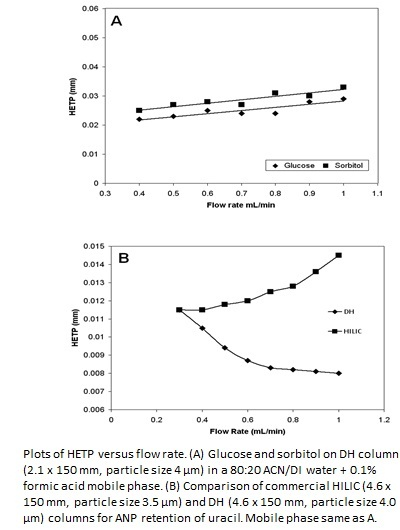
Van Deemter Comparisons
Comparisons of van Deemter behavior between conventional HILIC columns and TYPE-C™ silica hydride columns have demonstrated significant differences in efficiency characteristics. These observations suggest that the two stationary phase types operate through distinctly different retention processes.
Benefits for Method Development
Improved chromatographic efficiency can provide several practical advantages:
- Sharper peaks
- Improved resolution
- Better sensitivity
- Faster analyses
- Enhanced reproducibility
- Greater confidence in quantitation
These benefits can be particularly important in:
- LC-MS workflows
- Metabolomics
- Pharmaceutical analysis
- Clinical research
- Food and beverage testing
- Environmental monitoring
Equilibration and Reproducibility
One practical advantage frequently associated with TYPE-C™ technology is rapid equilibration.
Many laboratories report:
- Stable retention times
- Minimal retention drift
- Faster method startup
- Improved run-to-run reproducibility
These characteristics contribute significantly to long-term method robustness and analytical throughput.
Practical Implications for Polar Compound Analysis
For analysts working with:
- Organic acids
- Amines
- Metabolites
- Peptides
- Polar pharmaceuticals
- Charged compounds
the combination of strong HILIC retention and efficient chromatographic performance can simplify method development and improve overall analytical quality.
This is one reason Diamond Hydride™ and other TYPE-C™ columns are frequently selected for demanding polar compound applications.
Key Takeaways
- HILIC efficiency is influenced by the retention mechanism of the stationary phase.
- Conventional HILIC columns often rely on retention involving a water-enriched surface environment.
- TYPE-C™ silica hydride columns provide HILIC performance through a different retention mechanism historically known as ANP.
- Differences in retention mechanisms can lead to differences in chromatographic efficiency and mass transfer characteristics.
- Diamond Hydride™ columns frequently demonstrate excellent efficiency, reproducibility, and rapid equilibration.
- These properties can improve separations of challenging polar compounds in HPLC and LC-MS workflows.
