Date: 26-JANUARY-2013 Last Updated: 19-SEPTEMBER-2026
Introduction
Trifluoroacetic acid, commonly abbreviated as TFA, is one of the most widely used acidic mobile phase additives in liquid chromatography. Due to its strong acidity and ion-pairing characteristics, TFA is frequently incorporated into HPLC methods to improve chromatographic performance, particularly when analyzing basic compounds that may otherwise exhibit peak tailing or poor peak symmetry. TFA is commonly used in pharmaceutical, peptide, protein, and small-molecule analyses where improved peak shape and method robustness are important.
Chemical Structure of TFA
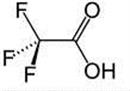
Chemical structure of trifluoroacetic acid (TFA), a strong organic acid commonly used as a mobile phase additive in HPLC methods.
What Is TFA?
TFA is the abbreviation for: Trifluoroacetic Acid. It is a strong organic acid containing three fluorine atoms attached to an acetic acid backbone. Because of its acidity and volatility, TFA is frequently used in chromatography to modify the chemical environment of the mobile phase and improve analyte behavior during separation.
Why TFA Is Used in HPLC
TFA can provide several chromatographic benefits, including:
- Improved peak symmetry
- Reduced peak tailing
- Suppression of unwanted secondary interactions
- Improved chromatographic reproducibility
- Enhanced retention consistency for some compounds
It is particularly useful for compounds that interact with residual silanol groups on silica-based stationary phases.
TFA and Silanol Interactions
Basic compounds may interact with negatively charged silanol groups on the stationary phase surface. These interactions can result in:
- Peak tailing
- Reduced efficiency
- Poor reproducibility
- Distorted chromatographic peaks
TFA helps minimize these effects by lowering the mobile phase pH and reducing silanol-related interactions. As a result, peak shape often improves significantly.
Ion-Pairing Characteristics of TFA
Although TFA is not typically used as a classic ion-pairing reagent, it exhibits ion-pairing behavior that can influence analyte retention and peak shape. These characteristics make it particularly useful for:
- Basic pharmaceuticals
- Peptides
- Polar analytes
- Nitrogen-containing compounds
Its ability to modify analyte interactions is one reason it remains a popular additive in analytical chromatography.
Typical TFA Concentrations in HPLC
For UV-detection methods, TFA is commonly used at approximately: 0.1% (v/v). This concentration often provides an effective balance of:
- Peak shape improvement
- Method robustness
- Reproducibility
Many reversed-phase methods employ:
- Water + 0.1% TFA as Mobile Phase A
- Acetonitrile + 0.1% TFA as Mobile Phase B
Because TFA is soluble in both water and acetonitrile, it is convenient to incorporate into gradient and isocratic methods.
TFA and LC-MS Compatibility
TFA is generally considered less desirable for LC-MS applications because it can suppress ionization efficiency in electrospray ionization (ESI) sources. Potential consequences include:
- Reduced MS sensitivity
- Lower analyte response
- Increased ion suppression
For this reason, many LC-MS methods prefer additives such as:
- Formic acid
- Acetic acid
- Ammonium formate
- Ammonium acetate
When TFA must be used with LC-MS, very low concentrations are often selected to minimize ion suppression while retaining chromatographic benefits.
When to Choose TFA
TFA is often an excellent choice when:
- UV detection is being used.
- Peak tailing is problematic.
- Basic compounds are being analyzed.
- Improved peak symmetry is needed.
- LC-MS sensitivity is not a primary concern.
In these situations, TFA can significantly improve the overall quality of the chromatographic separation.
When to Consider Alternatives
Alternative mobile phase additives may be preferable when:
- LC-MS sensitivity is critical.
- Maximum ionization efficiency is required.
- Trace-level quantitative analysis is being performed.
- Ion suppression must be minimized.
Formic acid is frequently selected in LC-MS methods because it generally provides better ionization efficiency than TFA.
Conclusion
Trifluoroacetic acid (TFA) is a versatile HPLC mobile phase additive that can improve peak shape, reduce silanol-related interactions, and enhance chromatographic reproducibility. It is particularly effective in UV-based methods and is commonly used at approximately 0.1% concentration. Although highly effective for chromatography, TFA can reduce LC-MS sensitivity through ion suppression, making alternative additives preferable for many mass spectrometry applications.