
Date: 9-APRIL-2013 Last Updated: 7-SEPTEMBER-2026
Introduction
The internal volume of tubing is an important parameter in HPLC, UHPLC, LC-MS, and other laboratory fluid-handling systems. Excess tubing volume can contribute to:
- Extra-column band broadening
- Gradient delay
- Peak dispersion
- Reduced chromatographic efficiency
- Longer system flushing times
Calculating tubing volume allows chromatographers to better understand the fluid path and optimize system performance.
Information Required
To calculate the internal volume of a tube, two dimensions are required:
- Length (L)
- Inside Diameter (ID)
Because tubing is essentially a cylinder, its internal volume can be calculated using the standard cylinder volume equation.
Unit Conversion
- Before performing the calculation, convert all dimensions to: Centimeters (cm)
- Useful conversion: 1 inch = 2.54 cm
- Using centimeters will produce a volume in: cm³
- Since: 1 cm³ = 1 mL the calculated value can be reported directly in milliliters.
- If desired, convert milliliters to microliters using: 1 mL = 1000 µL
Tubing Volume Formula
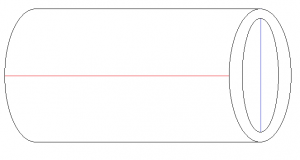
Tubing dimensions used for internal volume calculations showing length (L) and inside diameter (ID).
Formula
V = π (ID/2)2 L
Where:
- V = Internal volume
- ID = Inside diameter
- L = Length of tubing
- π = 3.14159
The formula calculates the volume of the cylindrical space inside the tubing.
Example Calculation
For tubing having:
- ID = 0.025 cm
- Length = 100 cm
The internal volume would be: V = π (0.025/2)² × 100. The resulting value represents the volume of liquid contained within the tubing at any given time.
Why Tubing Volume Matters in Chromatography
Internal tubing volume influences:
- Extra-column dispersion
- Gradient performance
- Retention time reproducibility
- Detector response
- LC-MS sensitivity
- System dead volume
As column dimensions become smaller, tubing volume becomes increasingly important because even small amounts of extra-column volume can affect chromatographic performance.
Applications
Tubing volume calculations are useful for:
- HPLC system optimization
- UHPLC method development
- LC-MS plumbing design
- Gradient delay calculations
- Fluid-path troubleshooting
- System suitability investigations
Understanding tubing volume can help improve resolution and maintain optimal instrument performance.
Tubing Product Information
Conclusion
The internal volume of tubing can be calculated using the cylinder volume equation once the tubing length and inside diameter are known. By converting dimensions to centimeters and applying the formula V = π(ID/2)²L, chromatographers can estimate system volume, evaluate extra-column effects, and optimize fluid-path performance in HPLC and LC-MS applications.