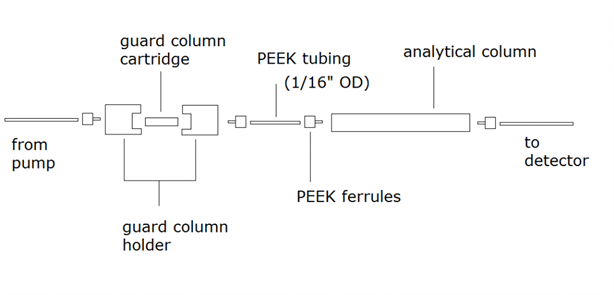
A reliable connection between a guard column and the analytical column protects the main stationary phase without sacrificing efficiency.
The recommended approach is to use a purpose‑built column coupler rather than improvised tubing assemblies, which can introduce unswept volume and degrade performance.
Preferred Method: Use a Column Coupler
Column couplers are designed to join a guard column holder directly to the analytical column with precisely machined, perpendicular cuts and minimal internal volume. This prevents mixing pockets and preserves plate count.
-
Why it matters: Properly made, low‑volume unions reduce dispersion at the junction and minimize peak broadening.
- Sizing guidance: Select the coupler bore based on expected flow; higher flows justify a slightly larger through‑hole to limit backpressure without adding excess volume.
Example recommendations: up to 0.5 mL/min → 0.005″ ID; ≤1.0 mL/min → 0.007″ ID; 1–2 mL/min → 0.010″ ID; ≥2 mL/min → 0.020″ ID.
Alternative (Not Recommended): PEEK Tubing + Ferrules
Although you can connect using short PEEK tubing and ferrules, this approach is not strongly recommended because achieving perfect, burr‑free, perpendicular cuts is difficult. Even small cutting or seating errors create unswept dead volume, leading to band broadening, ghost peaks, and sensitivity loss.
Assembly Tips to Maintain Efficiency
Regardless of hardware choice, follow these best practices to avoid extra‑column dispersion:
-
Keep the distance short: Minimize the gap between the guard holder and the analytical column to limit dispersion and delay volume.
-
Ensure perpendicular faces: Use unions/couplers supplied with square‑cut tubing faces to prevent gaps at the sealing surface.
-
Verify tight, coaxial seating: Re‑make connections if any play is detected; misalignment creates mixing pockets.
-
Confirm leak‑free installation: After assembly, run a low‑pressure leak test (e.g., lint‑free wipe/Kimwipe) and tighten incrementally until dry.
Conclusion
For dependable performance, connect your guard column holder to the analytical column using a dedicated column coupler sized for your flow rate.
This minimizes unswept volume and preserves chromatographic efficiency, whereas ad‑hoc PEEK tubing assemblies often introduce band‑broadening artifacts.