Introduction
In an effort to reduce laboratory consumable costs, some laboratories consider washing and reusing autosampler vials. While this practice may appear economical, it can introduce variables that negatively affect chromatographic data quality.
Autosampler vials are manufactured to provide a clean and consistent sample environment. Once a vial has been used, the original surface condition may be altered by sample exposure, washing procedures, cleaning agents, drying methods, or handling practices. These changes can affect both sample recovery and analytical reproducibility.
Why Reused Vials May Produce Different Results
After use, an autosampler vial may retain:
- Trace sample residues
- Cleaning agent residues
- Surface deposits
- Adsorbed compounds
- Microscopic surface changes
Even when a vial appears visually clean, low-level contamination may remain and become detectable in sensitive HPLC, UHPLC, or LC-MS analyses.
Potential Sources of Contamination
Washing procedures can introduce several unintended variables. Examples include:
- Residual detergents
- Organic cleaning solvents
- Water impurities
- Airborne contaminants
- Laboratory handling contamination
These contaminants may contribute to:
- Unexpected peaks
- Elevated background signals
- Carryover
- Baseline disturbances
Such effects can complicate method troubleshooting and data interpretation.
Impact on Sample Recovery
One of the less obvious consequences of vial reuse is variable analyte recovery. Over time, washing and reuse may alter the vial surface, potentially increasing opportunities for:
- Analyte adsorption
- Surface interactions
- Reduced recovery
- Concentration-dependent losses
The magnitude of these effects may vary depending on:
- Compound chemistry
- Sample concentration
- Solvent composition
- Cleaning procedure
This variability can make troubleshooting particularly difficult.
Why Variability Is a Concern
When sample loss occurs inconsistently, analysts may observe:
- Variable peak areas
- Poor reproducibility
- Unexpected assay results
- Increased %RSD values
- Method performance problems
Because the extent of loss may differ from vial to vial, identifying the root cause can become challenging.
Performance Study Results
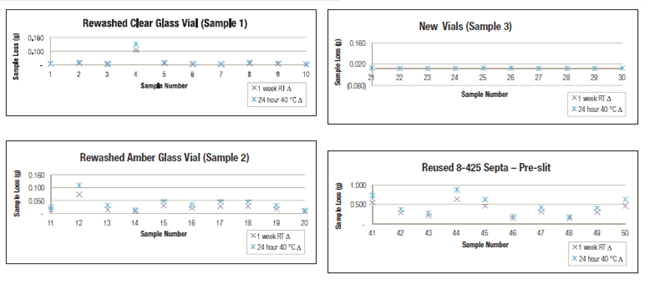
Comparison of sample recovery and analytical performance using new autosampler vials versus washed and reused autosampler vials. The charts illustrate how vial reuse may contribute to contamination and variable analyte recovery depending on the sample and vial condition.
Advantages of Using New Vials
Using new autosampler vials for each analysis helps eliminate several potential variables, including:
- Cross-contamination
- Residual cleaning agents
- Variable adsorption effects
- Unknown surface alterations
Benefits may include:
- Improved reproducibility
- More consistent sample recovery
- Reduced troubleshooting time
- Better quantitative accuracy
- Enhanced confidence in analytical results
Particular Concerns for LC-MS Methods
LC-MS and LC-MS/MS applications are especially sensitive to low-level contamination. Even trace amounts of residual compounds from previous samples or cleaning procedures can contribute to:
- Background ions
- Ghost peaks
- Signal suppression
- Reduced sensitivity
For these methods, the use of new vials is often considered best practice.
Best Practices
To minimize contamination and recovery issues:
- Use new autosampler vials whenever possible.
- Avoid reusing vials for quantitative analytical work.
- Use vials appropriate for the analytical method.
- Minimize handling after opening.
- Follow validated laboratory procedures for sample preparation.
These practices help maintain consistency and improve data quality.
Conclusion
Although washing and reusing autosampler vials may appear cost-effective, reuse can introduce contamination, alter vial surfaces, and contribute to inconsistent sample recovery. Studies have shown that new vials provide the most consistent performance, while reused vials may exhibit variable analyte loss and contamination effects. For laboratories seeking reliable quantitative results, particularly in HPLC, UHPLC, and LC-MS applications, the use of new autosampler vials remains the preferred approach.