Amiloride and Triamterene in Urine Analyzed by LC-MS - AppNote
December 29, 2014
/
/
/
/
Date: 2+DECEMBER-2014 Last Updated: 30-AUGUST-2026
LC-MS Method for Spiked Urine Sample
This application note describes the separation of two important drugs for treatment of hypertension and congestive heart failure. Both compounds have numerous amine groups, which can contribute to Peak tailing in some instances. However, the Peak shapes observed here are both symmetrical and very efficient.This is accomplished using the Diamond Hydride 2.o Column, which is well-suited to polar compounds such as these. A spiked Urine sample was used to demonstrate the applicability of the data to clinical studies.
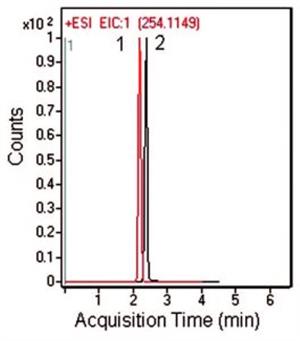
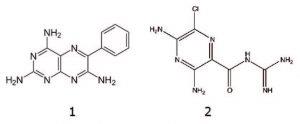
Peaks:
1. Triamterene
254.1149 m/z [M + H]+
2. Amiloride
230.0552 m/z [M + H]+
Column: Cogent Diamond Hydride 2.o™, 2.2 μm, 120Å
Catalog No.: 70200-05P-2
Dimensions: 2.1 x 50 mm
Mobile Phase:
— A: DI Water / 0.1% Formic Acid (v/v)
— B: Acetonitrile / 0.1% Formic Acid (v/v)
Gradient:
| Time (minutes) | %B |
| 0 | 80 |
| 3 | 30 |
| 5 | 30 |
| 6 | 80 |
Detection: ESI – POS – Agilent 6210 MSD TOF Mass Spectrometer
Injection vol.: 1 μL
Sample Preparation: Urine was spiked with Amiloride and Triamterene standard solutions and filtered with 0.45 um Nylon Syringe Filter.
Note: Amiloride and Triamterene are Potassium-sparing Diuretics. Trade names include Dyrenium® and Midamor®. They are also sometimes combined with Hydrochlorothiazide, a Diuretic drug.