Date: 30-DECEMBER-2014 Last Updated: 10-SEPTEMBER-2026
Introduction
While C18 columns remain the most commonly used reversed-phase stationary phases, certain analytical challenges require a different type of selectivity. Compounds with similar hydrophobicity may not be adequately resolved on conventional alkyl-bonded phases, particularly when the analytes contain aromatic rings, halogens, or subtle structural differences.
Pentafluorophenyl (PFP) stationary phases were developed to provide additional interaction mechanisms that can improve separation of these challenging compounds. Cogent™ PFP columns combine a pentafluorophenyl ligand with high-purity Type B silica to create a stationary phase capable of delivering unique chromatographic selectivity for specialized applications.
What Is a PFP Stationary Phase?
A PFP column utilizes a pentafluorophenyl ligand bonded to the silica surface. This fluorinated aromatic structure provides chromatographic interactions that differ significantly from those found in conventional C18 phases. The result is a stationary phase that can distinguish analytes based on more than simple hydrophobicity.
Stationary Phase Structure
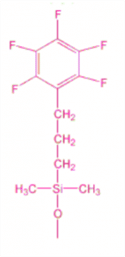
Basic structure of the pentafluorophenyl (PFP) stationary phase ligand used in Cogent™ PFP HPLC columns.
Unique Selectivity of PFP Columns
PFP phases can exhibit multiple retention mechanisms, including:
- Hydrophobic interactions
- Aromatic interactions
- Dipole interactions
- Shape selectivity
- Steric recognition
Because of these combined mechanisms, PFP columns often provide chromatographic behavior that differs substantially from traditional C18 columns.
Separation of Halogenated Compounds
One of the strengths of PFP stationary phases is the ability to improve separation of compounds containing:
- Fluorine
- Chlorine
- Bromine
- Iodine
These analytes can sometimes be difficult to distinguish on conventional reversed-phase columns. The unique electronic characteristics of the pentafluorophenyl ligand often provide improved selectivity for halogen-containing compounds and their related analogs.
Positional Isomer Separations
Positional isomers present a common challenge in chromatographic method development. Compounds that differ only in the location of a substituent on an aromatic ring may exhibit very similar retention on C18 columns. PFP columns are often useful for separating:
- Ortho isomers
- Meta isomers
- Para isomers
This enhanced selectivity can simplify method development and improve analytical confidence.
Aromatic Compound Analysis
The fluorinated aromatic surface of the PFP phase frequently provides improved selectivity for:
- Aromatic pharmaceuticals
- Environmental contaminants
- Agrochemicals
- Specialty chemicals
- Research compounds
These applications often benefit from the additional interaction mechanisms available with a PFP stationary phase.
When to Consider a PFP Column
A Cogent™ PFP column may be advantageous when:
- A C18 column does not provide sufficient resolution.
- Halogenated compounds must be separated.
- Positional isomers are present.
- Aromatic analytes require improved selectivity.
- Additional retention mechanisms are desired.
In many cases, simply changing stationary phase chemistry can be more effective than extensive mobile phase optimization.
Legacy but Still Valuable Technology
Although PFP phases are considered a specialized or legacy stationary phase compared to the widespread use of C18 chemistry, they continue to provide important advantages for selected applications. For analysts facing difficult separations, a PFP column can often provide selectivity that is not achievable with standard reversed-phase columns.
Applications
Cogent™ PFP columns are commonly used for:
- Halogenated pharmaceutical compounds
- Positional isomer separations
- Aromatic compound analysis
- Environmental testing
- Forensic analysis
- Specialty chemical analysis
- Method development studies
These applications benefit from the unique selectivity characteristics of the pentafluorophenyl stationary phase.
Conclusion
Cogent™ PFP HPLC columns utilize a pentafluorophenyl stationary phase that offers selectivity beyond traditional hydrophobic reversed-phase interactions. The phase is particularly useful for separating halogenated compounds, aromatic molecules, and positional isomers that may be difficult to resolve using conventional C18 columns. For challenging separations that require enhanced selectivity, the Cogent™ PFP phase remains a valuable chromatographic tool.