
Metaldehyde Pesticide in Slug Pellets Analyzed by LCMS - AppNote
February 6, 2015
/
/
/
Pesticide Formulation
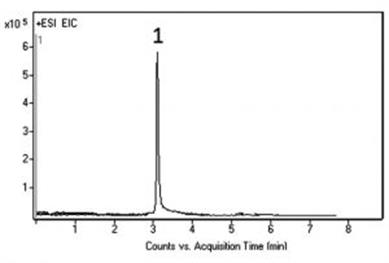
As Metaldehyde is a non-UV absorbing compound, other detection methods needed to be investigated besides conventional UV-HPLC. LC-MS was found to be a well-suited analysis by searching for the EIC corresponding to the [M+H]+ ion. Good retention and peak shape were observed for this analyte using the Cogent Bidentate C18 2.o™ Column.
Column: Cogent Bidentate C18 2.o™, 2.2 μm, 120 Å
Catalog No.: 40218-05P-2
Dimensions: 2.1 x 50 mm
Mobile Phase:
-- A: DI Water / 0.1% Formic Acid
-- B: Acetonitrile / 0.1% Formic Acid
Gradient:
Post Time: 3 minutes
Injection vol.: 1 μL
Flow rate: 0.4 mL / minute
Detection: ESI – POS - Agilent 6210 MSD TOF Mass Spectrometer
Sample: Slug pellets (containing 3.25% Metaldehyde) were ground and 800 mg was transferred to a 25 mL volumetric flask. A portion of 50 / 50 Solvent A / Solvent B diluent was added and the flask was sonicated for 10 minutes. Then it was diluted to mark, mixed thoroughly, and filtered with a 0.45 um Nylon Syringe Filter (MICROSOLV Tech Corp.).
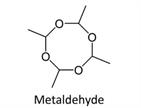
Note: Metaldehyde is a cyclic tetramer of Acetaldehyde. Slug pellets contain wheat as bait with a small amount of Metaldehyde. These pellets are sold widely under a variety of trade names, such as Ariotox®, Cekumeta®, Deadline®, and others.

Attachment No 317 Metaldehyde in Slug Pellets pdf 0.2 Mb Download File
As Metaldehyde is a non-UV absorbing compound, other detection methods needed to be investigated besides conventional UV-HPLC. LC-MS was found to be a well-suited analysis by searching for the EIC corresponding to the [M+H]+ ion. Good retention and peak shape were observed for this analyte using the Cogent Bidentate C18 2.o™ Column.
Peak:
Metaldehyde
177.1121 m/z [M + H]+
Column: Cogent Bidentate C18 2.o™, 2.2 μm, 120 Å
Catalog No.: 40218-05P-2
Dimensions: 2.1 x 50 mm
Mobile Phase:
-- A: DI Water / 0.1% Formic Acid
-- B: Acetonitrile / 0.1% Formic Acid
Gradient:
| Time (minutes) | %B |
|---|---|
| 0 | 10 |
| 3 | 100 |
| 6 | 100 |
| 7 | 10 |
Post Time: 3 minutes
Injection vol.: 1 μL
Flow rate: 0.4 mL / minute
Detection: ESI – POS - Agilent 6210 MSD TOF Mass Spectrometer
Sample: Slug pellets (containing 3.25% Metaldehyde) were ground and 800 mg was transferred to a 25 mL volumetric flask. A portion of 50 / 50 Solvent A / Solvent B diluent was added and the flask was sonicated for 10 minutes. Then it was diluted to mark, mixed thoroughly, and filtered with a 0.45 um Nylon Syringe Filter (MICROSOLV Tech Corp.).
Note: Metaldehyde is a cyclic tetramer of Acetaldehyde. Slug pellets contain wheat as bait with a small amount of Metaldehyde. These pellets are sold widely under a variety of trade names, such as Ariotox®, Cekumeta®, Deadline®, and others.
Attachment No 317 Metaldehyde in Slug Pellets pdf 0.2 Mb Download File