
Date: 17-MAY-2015 Last Updated: 20-AUGUST-2026
Codeine, Hydroxybupropion, Warfarin
Introduction
Quantitative LC-MS analysis of plasma samples is a critical tool in pharmaceutical research, clinical testing, toxicology investigations, and forensic applications. As mass spectrometry technology continues to improve, laboratories are achieving lower detection limits, increased specificity, and greater confidence when analyzing drugs and metabolites in biological samples.
Despite these advances, plasma remains one of the most challenging sample matrices due to its complexity and the presence of endogenous compounds that can interfere with chromatographic and MS performance.
This application note highlights the analysis of three representative compounds:
- Warfarin
- Hydroxybupropion
- Codeine
using LC-MS and Cogent™ TYPE-C™ chromatography columns.
Analytical Challenges in Plasma Analysis
Biological matrices often contain a wide range of compounds that can complicate chromatographic analysis, including:
- Proteins
- Lipids
- Salts
- Endogenous metabolites
- Pharmaceutical compounds
- Drug metabolites
Common analytical challenges include:
- Matrix interference
- Co-eluting compounds
- Limited retention of polar analytes
- Reduced LC-MS sensitivity
- Elevated background noise
- Carryover and contamination
Successful plasma methods require both effective chromatographic retention and selective mass spectrometric detection.
Advantages of TYPE-C™ Columns for Plasma Samples
Cogent™ TYPE-C™ silica hydride-based columns can be used under both:
- HILIC conditions
- Reversed Phase conditions
This flexibility allows method developers to optimize retention for a broad range of analyte classes, from highly polar metabolites to hydrophobic pharmaceutical compounds.
Advantages include:
- Retention of polar analytes that may be difficult to retain using conventional reversed phase methods
- LC-MS compatibility
- Flexible method development options
- Unique selectivity for complex mixtures
- Reduced impact from residual silanol interactions
These characteristics can be particularly valuable when working with challenging biological matrices.
Plasma Matrix Considerations
Plasma samples can gradually introduce contaminants into chromatographic systems.
Potential effects include:
- Increased background response
- Baseline disturbances
- Ghost peaks
- Reduced sensitivity
- Accumulation of matrix residues
TYPE-C™ columns can often be maintained using routine washing procedures that may be incorporated into analytical methods or performed as separate column maintenance steps.
Proper cleaning and maintenance help preserve chromatographic performance over extended use.
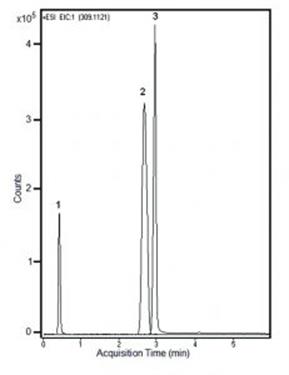
Peak Identification
- Peak 1: Warfarin
- Peak 2: Hydroxybupropion
- Peak 3: Codeine
Applications
This LC-MS approach is applicable to:
- Clinical testing
- Pharmacokinetic studies
- Drug metabolism research
- Toxicology investigations
- Forensic analysis
- Bioanalytical method development
- Pharmaceutical research
The methodology demonstrates how multiple analyte classes can be analyzed from plasma using TYPE-C™ chromatography.
Extended Technical Study
The complete application note contains:
- Full chromatographic conditions
- LC-MS parameters
- Method details
- Chromatograms
- Analytical results
- Sample preparation information
- Performance data
Refer to the complete technical study for detailed experimental conditions and supporting data.
Key Takeaways
- Plasma analysis presents unique chromatographic and LC-MS challenges.
- Codeine, hydroxybupropion, and warfarin were analyzed using TYPE-C™ chromatography and LC-MS detection.
- TYPE-C™ columns provide flexibility for both HILIC and reversed phase methods.
- Biological matrices can benefit from selective retention and LC-MS compatibility.
- Proper column maintenance helps reduce the impact of plasma-derived contaminants.
- The complete application note contains detailed method parameters and analytical results.
Additional Resources
For LC-MS method development guidance, TYPE-C™ column specifications, bioanalytical applications, product images, and ordering information, view: Cogent™ TYPE-C™ Column Specifications, Bioanalytical LC-MS Applications, Product Images, and Ordering Information