Date: 23-SEPTEMBER-2015 Last Updated: 5-SEPTEMBER-2026
Introduction
Poor peak shape is one of the most common chromatographic issues encountered during HPLC method development and routine analysis. While column chemistry, mobile phase composition, and system performance are often investigated first, the sample diluent itself is frequently overlooked.
A mismatch between the sample diluent and the mobile phase can significantly affect how analytes are introduced onto the column. In some cases, this mismatch can distort peak shape even when all other aspects of the method are functioning properly.
What Is Sample Diluent Mismatch?
Sample diluent mismatch occurs when the solvent used to prepare the sample differs substantially from the starting mobile phase composition.
The most common scenario is when:
- The sample is dissolved in a strong organic solvent.
- The chromatographic method begins under highly aqueous conditions.
In this situation, analytes enter the column in a solvent environment that is much stronger than the mobile phase, which can interfere with proper analyte focusing at the column inlet.
Example Using Resveratrol
A useful example involves resveratrol samples prepared in: 100% Acetonitrile while the chromatographic method begins with a mobile phase containing approximately: 80% Aqueous Content
Under these conditions, the sample solvent is substantially stronger than the mobile phase.
This mismatch can result in:
- Distorted peaks
- Broadened peaks
- Peak fronting
- Reduced efficiency
- Poor quantitative performance
The issue originates from the injection solvent rather than the analytical column.
Effect on Peak Focusing
When a sample dissolved in a strong solvent enters a predominantly aqueous mobile phase, the analyte may not properly focus at the head of the column. Instead of forming a narrow analyte band, dispersion occurs before effective chromatographic retention begins.
Potential consequences include:
- Poor peak symmetry
- Reduced peak height
- Loss of resolution
- Lower sensitivity
- Increased integration variability
These effects can become more pronounced as injection volume increases.
Graphic Comparison
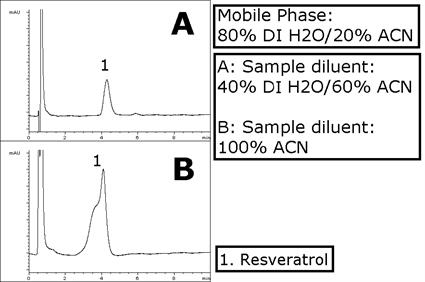
Comparison of chromatographic peak shape obtained using different sample diluents. The graphic demonstrates the effect of sample diluent strength relative to the starting mobile phase composition.
Best Practice for Sample Diluent Selection
The preferred approach is: Use a sample diluent that matches the mobile phase whenever possible.
Matching the diluent to the starting mobile phase helps promote proper analyte focusing and often produces the best chromatographic performance.
Benefits include:
- Improved peak shape
- Better peak symmetry
- Increased sensitivity
- Improved reproducibility
- Reduced risk of fronting and broadening
When an Exact Match Is Not Possible
In some cases, analyte solubility requirements prevent using the exact mobile phase composition as the sample diluent.
When this occurs: Use a diluent that is as close to the starting mobile phase composition as practical.
This approach helps minimize solvent-strength differences while maintaining analyte solubility. The closer the diluent composition is to the initial mobile phase conditions, the lower the likelihood of injection-related peak distortion.
Signs of Diluent Mismatch
Symptoms often include:
- Fronting peaks
- Peak broadening
- Split peaks
- Reduced efficiency
- Poor reproducibility
- Differences between standards and samples
- Improvement when injection volume is reduced
These symptoms may appear even when the column and instrument are functioning properly.
Additional Factors to Consider
The severity of diluent mismatch effects may depend on:
- Injection volume
- Mobile phase strength
- Analyte retention
- Column dimensions
- Column particle size
- Sample concentration
Strongly retained compounds are often less affected than compounds that elute near the column void volume.
Conclusion
Sample diluent mismatch is a common but frequently overlooked cause of poor HPLC peak shape. Using a diluent that is significantly stronger than the starting mobile phase can prevent proper analyte focusing and lead to broad, distorted, or fronting peaks. Whenever possible, the sample diluent should match the mobile phase or be formulated as close to it as practical to ensure optimal chromatographic performance.