Date: 6-AUGUST-2022 Last Updated: 5-SEPTEMBER-2026
Sugars can be difficult to analyze by HPLC due to their polarity.The chromatographic analysis of simple sugars can be challenging due to their highly polar nature and limited retention in conventional reversed-phase HPLC systems. As a result, many laboratories rely on HILIC-based approaches or specialized stationary phases for carbohydrate separations.
Challenges with Traditional Amine Columns
Amine-bonded stationary phases are commonly used for the analysis of monosaccharides and other polar carbohydrates because they can provide adequate retention and selectivity.
However, reducing sugars such as D-ribose and D-xylose contain aldehyde functionality that can react with amine ligands on the stationary phase. This reaction may result in Schiff base formation, which can gradually alter the chromatographic surface and reduce column performance over time.
Potential consequences include:
- Reduced column lifetime
- Loss of retention
- Changes in selectivity
- Reduced method robustness
- Increased column replacement frequency
Advantages of Cogent Amide Columns
The Cogent Amide stationary phase provides an alternative approach for carbohydrate analysis by utilizing an amide functionality that is significantly less reactive than conventional amine phases.
Benefits may include:
- Consistent retention of polar sugars
- Improved column longevity
- Reduced risk of Schiff base formation
- Improved method robustness
- Reliable HILIC performance
These characteristics make the column well suited for routine carbohydrate analyses involving aldoses and related compounds.
Ribose and Xylose Separation
This method demonstrates the separation of two structurally similar aldopentose sugars:
Peaks
- D-Ribose
- D-Xylose
Despite differing only by the configuration of a single chiral center, the method provides effective chromatographic discrimination between the two analytes.
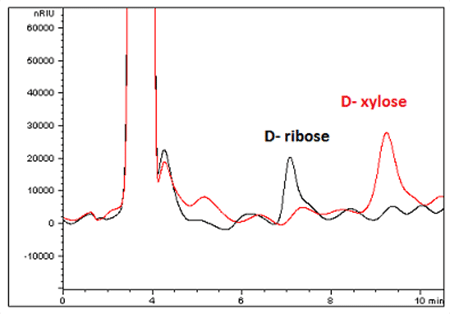

Peaks: 1. D-Ribose, 2. D-Xylose
Method Conditions:
Column: Cogent Amide™, 4 μm, 100 Å
Catalog No.: 40036-10P
Dimensions: 4.6 x 100 mm
Mobile Phase: 95% acetonitrile / 5% DI water / 0.1% triethylamine (TEA) (v/v)
Flow Rate: 0.5 mL / minute
Detection: Refractive index
Injection Volume: 5 ul
Sample Preparation: D-ribose and D-xylose reference standards (3 mg/mL) in diluent of 50% acetonitrile / 50% DI water / 0.1% TEA (v/v)
Note: Ribose and xylose are aldopentoses that differ only by a chiral center. In addition to the open chain forms, these sugars exist in equilibrium with ring forms (five or six members) as well as α and β anomers. Both sugars are highly polar and not generally suitable for conventional Reversed Phase retention.