Hydroxychloroquine Sulfate Analysis by HILIC HPLC - AppNote
Date: 27-MAY-2020 Last Update: 22-AUGUST-2026
Hydroxychloroquine Sulfate presents a few Complexities to Routine Chromatographic Analysis.
The Amine Groups also interact with lone-Silanols, causing Peak Tailing on regular Silica Columns. In typical Reversed Phased Modes, Buffers are needed in higher concentrations to aid in retention, as well as Ion Pair Reagents. These additives can hinder coupling in Mass Spectrometry and also increases the likelihood of source Contamination. However, the use of a Cogent Diamond Hydride™ Column in HILIC mode illustrates how Hydroxychloroquine can be readily retained, with good run-to-run precision, and Excellent Peak Shape without Ion Pairing Reagents. (%RSD = 0.09, SD below 0.004.)This method demonstrates an easy HPLC method that can be quite readily transferred to LCMS.
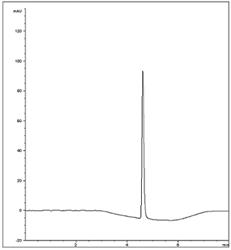
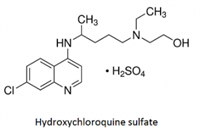
Peak: Hydroxychloroquine Sulfate
Method Conditions:Column: Cogent Diamond Hydride™, 4 μm, 100 Å
Catalog No.: 70000-75P
Dimensions: 4.6 x 75 mm
Mobile Phase:
- A. DI Water / 0.1% Formic Acid (v/v)
- B. Acetonitrile / 0.1% Formic Acid (v/v)
Gradient:
| Time (minutes) | %B |
|---|---|
| 0 | 80 |
| 1 | 80 |
| 3 | 50 |
| 4 | 50 |
| 5 | 80 |
| 8 | 80 |
Injection Volume: 1ul
Flow Rate: 1.0 ml / minute
Detection: 254 nm
Sample Preparation: 0.1 mg / mL Hydroxychloroquine Sulfate in 50:50 Acetonitrile: DI H2O
Note: Hydroxychloroquine is an inexpensive antimalarial drug, now regarded as a safe and reasonably effective treatment for various autoimmune rheumatic diseases including systemic lupus erythematosus.