ADMA and SDMA Separation analyzed with ELSD - AppNote
March 28, 2025
/
/
/
Date: 28-MARCH-2025 Last Updated: 31-AUGUST-2026
Separation of Structural Isomers
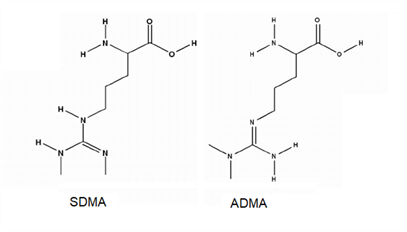
ADMA (Asymmetric Dimethylarginine) and SDMA (Symmetric Dimethylarginine) are structural isomers and isobaric compounds, sharing the same m/z value. Separating these compounds is crucial, even when using LC-MS detection. While MS-MS detection can differentiate these compounds based on their distinct fragmentation patterns, the availability of such detection is not always guaranteed.This method utilizes ELSD and demonstrates the separation of both compounds using the Diamond Hydride.
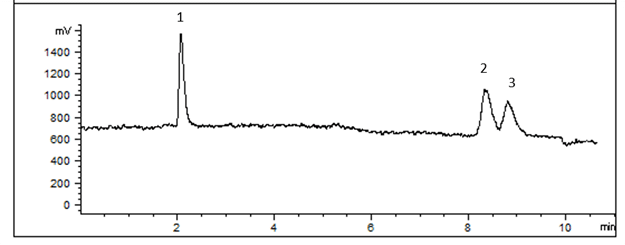
Peaks:
1. Unknown
2. SDMA 3. ADMA
Column: Cogent Diamond Hydride™, 4 µm, 100Å
Catalog No.: 70000-10P
Dimensions: 4.6 mm x 100 mm
Mobile Phase:
A: 50%DI water/10 mM ammonium formate, pH 4.9
B: Acetonitrile 90%/10% DI water+10 mM ammonium formate pH: 5.12
Injection vol.: 3 µL
Flow rate: 0.5 mL / minute
Detection: ELSD, temp: 500 C, Gain
Sample Preparation: 0.1 mg / mL ADMA + SDMA in 50:50 ACN:DI Water
| Time ( minutes ) | %B |
|---|---|
| 0 | 20 |
| 1 | 30 |
| 5 | 30 |
| 6 | 50 |
| 7 | 50 |
| 8 | 90 |
| 9 | 90 |
| 11 | 20 |
| 15 | 20 |
Note: The method employed utilized a Reverse Phase chromatography gradient with a Cogent Diamond Hydride™.
It is important to note that this method requires longer equilibration times—approximately 10 to 15 minutes—between runs to ensure reproducible results.