Date: 17-SEPTEMBER-2026 Last Updated: 17-SEPTEMBER-2026
Isocratic Method Separating Diastereomers
Introduction
Ephedrine and pseudoephedrine are closely related pharmaceutical compounds widely used in decongestant formulations and analytical reference standards. Although they share identical molecular weights and very similar chemical structures, they differ in stereochemistry and are classified as diastereomers. Because of their structural similarity, achieving adequate chromatographic separation can be challenging. Many published methods rely on:
- Ion-pair reagents
- Highly buffered mobile phases
- Complex gradient conditions
- Specialized stationary phases
- Chiral chromatography
This application note demonstrates a straightforward isocratic method that effectively separates (+)-ephedrine hydrochloride and (1S,2S)-(+)-pseudoephedrine using a standard reversed-phase Cogent™ Bidentate C18 column.
Benefits of This Method
This approach offers several advantages:
- Simple isocratic operation
- No ion-pair reagents required
- MS-friendly mobile phase composition
- Conventional reversed-phase chromatography
- Easy method implementation
- Excellent reproducibility
- Suitable for pharmaceutical testing laboratories
The method illustrates how carefully optimized stationary phase chemistry can provide sufficient selectivity for challenging diastereomer separations without requiring specialized chromatographic techniques.
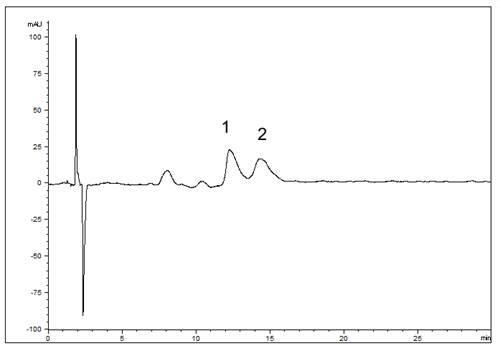
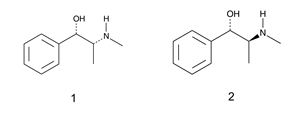
Peaks: 1. (+)-Ephedrine Hydrochloride and 2. (1S,2S)-(+)-Pseudoephedrine
Method Conditions
Column:
Cogent Bidentate C18™, 4 μm, 100 Å
Catalog No.
:
40018-15P
Dimensions
: 4.6 x 150mm
Mobile Phase
: 97:3 DI Water /
Acetonitrile /
0.1% formic acid
Injection vol.
: 5μL
Flow rate
: 1.0 mL/minute
Detection
: UV @ 205 nm
Sample Preparation
: Ephedrine and pseudoephedrine, 0.1 mg in 50:50 ACN:DI Water.
Note: Both compounds were originally isolated from plants of the genus Ephedra , which has been used in traditional medicine for thousands of years and its discovery helped bridge traditional herbal medicine and modern pharmaceutical science. Before modern inhalers became common, ephedrine-containing preparations were widely used for asthma treatment because of their bronchodilating effects.