Date: 05-August-2026 Last Updated: 30 -August-2026
Vancomycin is a glycopeptide antibiotic commonly administered by intravenous infusion, often following dilution in dextrose-containing solutions. Simultaneous analysis of vancomycin and glucose can be useful for formulation development, compatibility studies, and stability testing. Because both compounds are highly polar and exhibit limited retention in conventional reversed-phase chromatography, HILIC using a Cogent Amide™ column provides an effective approach for their separation and analysis in a single chromatographic run.
Note: The large baseline peak observed during the gradient transition is due to the ELSD response to changing mobile phase composition. Changes in solvent volatility and droplet evaporation characteristics during the gradient can create a broad detector response that is not associated with any sample analyte.
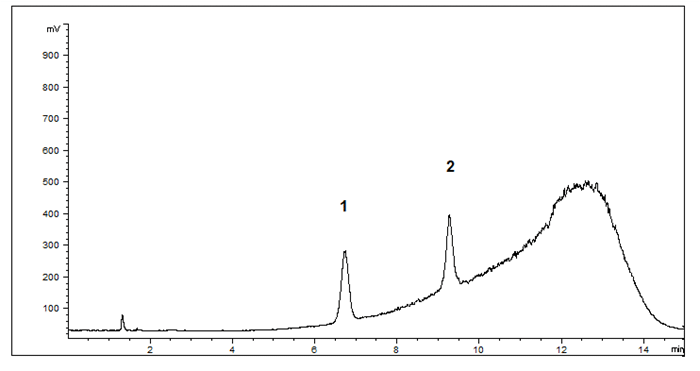
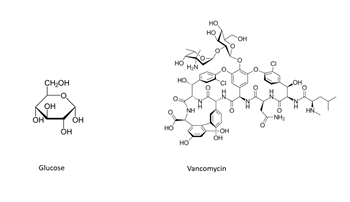
Peaks: 1. Glucose 2. Vancomycin
Method Conditions:
Column: Cogent Amide™, 4 μm, 100 Å
Catalog No.: 40036-15D
Dimensions: 4.6 x 150 mm
Mobile Phase:
B: Acetonitrile / 0.1% Triethylamine (TEA) (v/v)
Gradient:
| Time (minutes) | %B |
|---|---|
| 0 | 90 |
| 1 | 90 |
| 10 | 70 |
| 11 | 90 |
| 15 | END |
Flow Rate: 1.0 mL / minute
Detection: ELSD with a Gain 8, Temp 50C, Nitrogen: 3.5lb
Injection Volume: 2 uL
Sample Preparation: Separate stock solutions of glucose 3.6 mg / mL and Vancomycin 2.3 mg / mL were prepared. A working standard was prepared by mixing 200 µL of each stock solution with 600 µL of diluent 50:50 acetonitrile / DI water containing 0.1% TEA, v/v, resulting in final concentrations of 0.72 mg / mL glucose and 0.46 mg / mL Vancomycin.
Note: Vancomycin is a glycopeptide antibiotic used to treat serious Gram-positive infections and is frequently formulated for intravenous administration in dextrose-containing solutions.