
Date: 11-MAY-2012 Last Updated: 22-AUGUST-2026
Nucleotide Sugars UDP, ADP, TDP and CDP
UDP Hexanolamine was used as the Internal Standard in the analysis of Nucleotide Sugars in this rapid analysis Method. The Mobile Phase was designed to maximize the detector response in LCMS for maximum Chromatographic Efficiency. The simple “Inverse Gradient” which produces a HILIC mode HPLC Method, was required for the results shown.
This Method can be used in measuring Metabolite Concentration.
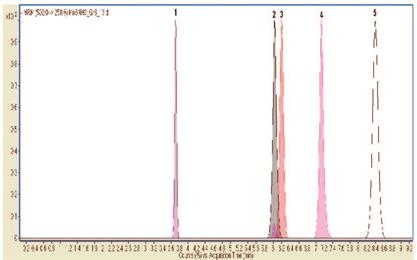
Peaks:
1. ADP–Glucose,
RT = 3.68 min, monitored MRM transitions were m/z 588 to m/z 346
2. Proprietary Sugar Nucleotide,
RT = 6.03 min, monitored MRM transitions were m/z 563 to m/z 321
3. Proprietary Sugar Nucleotide,
RT = 6.20 min, monitored MRM transitions were m/z 606 to m/z 385
4. CDP–Glucose,
RT = 7.13 min, monitored MRM transitions were m/z 564 to m/z 322
5. UDP Hexanolamine (internal standard),
RT = 8.40 min, monitored MRM transitions were m/z 502 to m/z 258
MRM = Multiple Reaction Monitoring in LCMS/MS
Method Conditions
Column: Cogent Diamond Hydride™, 4 μm, 100 Å
Catalog No.: 70000-15P-2
Dimensions: 2.1 x 150 mm
Mobile Phase:
- A: DI Water / 0.1% Ammonium Formate pH 7.2
- B: 90:10 Acetonitrile / DI Water / 0.1% Ammonium Formate pH 6
Gradient:
|
Time (minutes) |
%B |
|---|---|
|
0 |
95 |
|
10.0 |
75 |
|
12.0 |
75 |
|
12.1 |
95 |
|
15.0 |
95 |
Flow rate: 0.3 mL / minute
Sample Preparation: 400 mL DI Water / 400 mL Acetonitrile / 20 mL of Stock Solution of each compound / 5 mL of 12% ammonia
Detection: ESI – NEG - Agilent 6210 MSD TOF Mass Spectrometer
Note: Please note the addition of small amount of Ammonia to the Sample Matrix. The alkaline environment of the Sample Matrix assured Efficient and Symmetrical Peaks for all analytes.
