
Date: 20-JUNE-2016 Last Updated: 15-AUGUST-2026
Overview
Advanced structural characterization techniques are often used to verify the chemistry of chromatographic stationary phases. One of the most effective methods for evaluating bonded-phase structures is solid-state Nuclear Magnetic Resonance (NMR) spectroscopy.
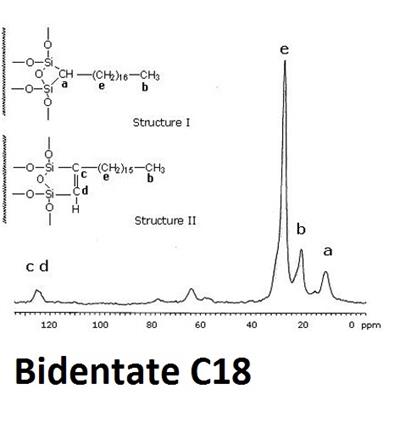
For Cogent™ Bidentate C18 stationary phases, solid-state ^13C Cross Polarization Magic Angle Spinning (CP-MAS) NMR was used to examine the bonded surface chemistry and verify the structure of the C18 ligand attached to the TYPE-C™ silica-hydride support.
The resulting spectrum provides direct evidence of the stationary phase architecture and confirms the presence of the bonded carbon environments expected for this material.
Why Solid-State NMR Is Important
Unlike solution-phase NMR techniques, solid-state CP-MAS NMR allows direct examination of chromatographic packing materials without removing the bonded ligands from the support surface.
This technique is useful for:
- Confirming bonded-phase chemistry
- Identifying carbon environments
- Verifying surface modification
- Supporting quality control programs
- Characterizing stationary phase structures
For chromatography columns, these studies help demonstrate that the intended bonded phase has been successfully incorporated onto the silica support.
Structural Features of the Bidentate C18 Phase
The Cogent™ Bidentate C18 stationary phase utilizes a unique bonding approach based on TYPE-C™ silica technology.
A key feature of this chemistry is the bidentate attachment of the bonded ligand to the silica-hydride surface.
This type of bonding differs from many conventional silica-based C18 phases and contributes to the distinct surface characteristics of the stationary phase. The NMR data provide evidence supporting this unique structural arrangement.
Carbon Assignments and Spectrum Interpretation
The solid-state ^13C CP-MAS NMR spectrum contains signals corresponding to the various carbon environments present within the bonded phase structure.
Assignments of these carbon resonances help verify:
- Presence of the C18 ligand
- Surface attachment chemistry
- Bonded-phase integrity
- Stationary phase consistency
Analysis of the spectrum confirms the expected carbon distribution associated with the Bidentate C18 stationary phase.
NMR Spectrum
TYPE-C™ Silica Technology
Cogent™ Bidentate C18 phases are built upon TYPE-C™ silica-hydride technology rather than conventional silica surfaces.
The resulting chemistry offers a unique platform for chromatographic separations and contributes to the distinctive characteristics observed during both structural analysis and chromatographic performance evaluations. The NMR data help illustrate these structural differences at the molecular level.
Applications of Structural Characterization
Verification of bonded-phase chemistry through solid-state NMR supports:
- Product development
- Manufacturing consistency
- Surface chemistry validation
- Quality assurance initiatives
- Scientific understanding of stationary phase design
These studies provide an important foundation for advanced chromatography column technologies.
Key Takeaways
- Solid-state ^13C CP-MAS NMR was used to characterize the Cogent™ Bidentate C18 stationary phase.
- The spectrum confirms the expected bonded-phase structure.
- Carbon assignments support the presence of the C18 ligand.
- The data demonstrate the unique bidentate bonding arrangement.
- The chemistry differs from conventional silica-based C18 stationary phases.
- Structural characterization supports product quality and scientific validation.
