
Octreotide Analyzed by LC-MS - AppNote
August 11, 2017
/
/
/
Date: 11-AUGUST-2017 Last Updated: 22-AUGUST-2026
Octreotide Retained Isocratically or With a GradientThis cyclic Octapeptide can be retained with simple Isocratic Mobile Phase conditions of 50:50 Solvent A / Solvent B (see Figure I). In addition, use of a Gradient produces a sharper Peak if desired (Figure II). Note, that the Gradient starts at an unusually high percent of Water (50%) for a HILIC mode application, due to the highly polar nature of the molecule.
With its two basic Amino Acid residues, the Octapeptide may lead to tailing due to silanolic interactions on some conventional Silica-based HPLC stationary phases, but here the peak shape is very symmetrical.
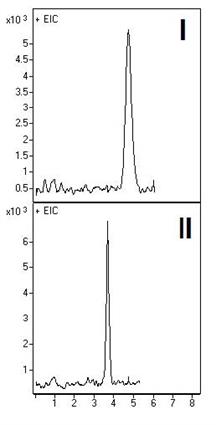
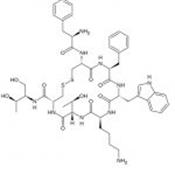
Peak: Octreotide
Method Conditions:Column: Cogent Diamond Hydride™, 4 µm, 100 Å
Catalog No.: 70000-15P-2
Dimensions: 2.1 x 150 mm
Solvents:
-- A: DI Water / 0.1% Formic Acid (v/v)
-- B: Acetonitrile / 0.1% Formic Acid (v/v)
Figure I: 50% solvent A/ 50% solvent B
Figure II: Gradient:
| Time (Minute) | %B |
|---|---|
| 0 | 50 |
| 3 | 20 |
| 6 | 20 |
| 7 | 50 |
Injection Volume: 1 µL
Flow Rate: 0.4 mL / minute
Detection: ESI – POS - Agilent 6210 MSD TOF Mass Spectrometer
Sample Preparation: Reference standard solution of Octreotide
Notes: Octreotide mimics the naturally occurring hormone Somatostatin. It is used for the treatment of growth hormone producing tumors and other related medical applications.
