
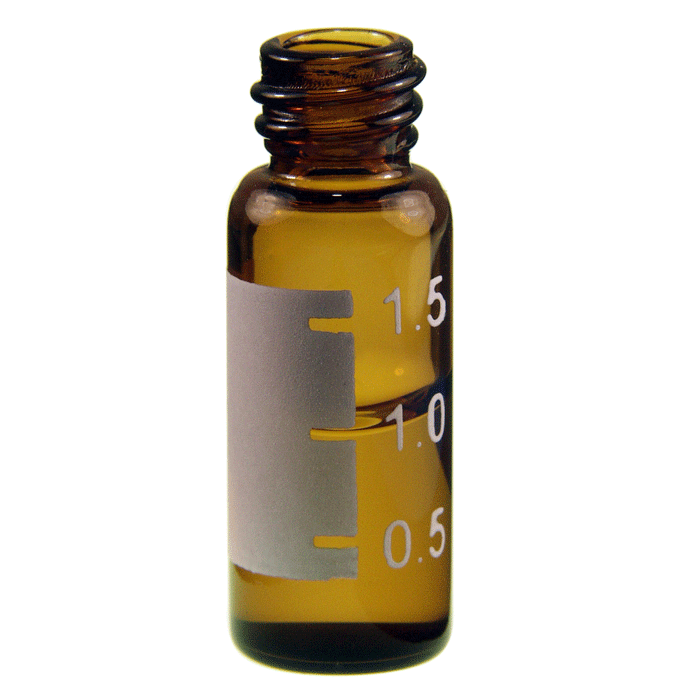
Vials, Screw Top, Glass. Amber, 2ml, with Write-On Patch and fill lines, 8-425mm threads, 12x32mm outer dimensions. For use as an autosampler vial or storage bottle. BASIK Brand. 100/PK.
Additional Information:
The 9582S‑WAV BASIK™ Amber Screw‑Top Autosampler Vial is a cost‑effective, narrow‑mouth 2 mL vial designed for light‑sensitive samples, stability testing, and sample storage. Manufactured from first hydrolytic, Class A borosilicate glass, the amberized vial provides dependable chemical durability while offering low‑actinic light protection for photosensitive compounds.
The narrow 8‑425 opening may help reduce evaporation during extended storage compared to wider‑mouth vials. Integrated write‑on patches and fill lines, applied using epoxy paint, allow clear, smear‑resistant sample identification throughout routine handling and storage.
Key Features
Amber Borosilicate Glass Construction
First hydrolytic, Class A borosilicate glass
Amberized for protection of light‑sensitive compounds
Considered low actinic for routine analytical use
Narrow‑Mouth 8‑425 Thread Design
Smaller opening compared to standard 9‑425 vials
May help reduce solvent evaporation
Requires 8‑425 screw caps and septa
Write‑On Patch and Fill Lines
Epoxy paint write‑on area resists smearing during use
Fill lines support consistent sample volumes
Ideal for labeling samples in stability studies
Standard Autosampler and Storage Compatibility
12 × 32 mm dimensions fit common autosampler trays
Suitable for use as an autosampler vial or storage bottle
Designed for routine, non‑critical workflows
Why Choose BASIK™ Amber Narrow‑Mouth Write‑On Vials?
The 9582S‑WAV is selected when laboratories need:
A low‑cost amber 2 mL screw‑top vial
Light protection without specialized surface treatments
Narrow‑mouth geometry to help limit evaporation
Clear labeling for stability testing and sample retention
These vials are widely used in stability studies, sample retention programs, and QC laboratories where value, usability, and light protection are priorities.
Typical Applications
Stability testing
Sample storage and retention
Light‑sensitive compounds
Routine HPLC autosampling
Quality control and research workflows