
Date: 14-MAY-2012 Last Update: 12-AUGUST-2026
Forced Degradation Methods
Cogent™
HPLC
Column
Specifications,
Selectivity
Options,
Applications,
Configurations,
and
Ordering
Information
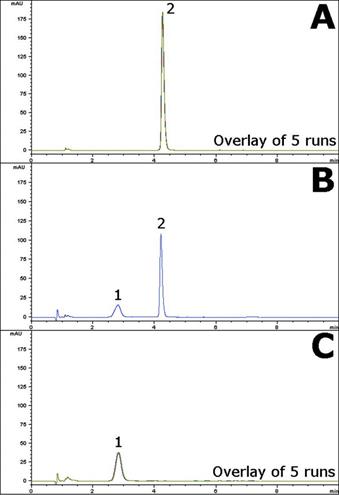
Forced degradation studies are useful for developing Stability Indicating Methods of Pharmaceuticals. In this Application Note Separation is obtained between the API and a Degradant formed under two different, strong acidic conditions. The non-degraded Sample produced a sharp, Symmetrical Peak for the API shown in
Figure A.
In Figure B, strong acid conditions without heating produced a degradant while the API Peak was still present. In Figure C, acid degradation with heating completely converted the API into the degradant, as the API Peak was no longer observed.
Five Chromatograms are overlaid and presented below to show Method Robustness and Precision.
Peaks:
1. Degradant,
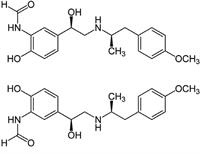
2. Formoterol
Showing Enantiomers
Method Conditions
Column: Cogent Phenyl Hydride™, 4 μm, 100 Å
Catalog No.: 69020-7.5P
Dimensions: 4.6 x 75 mm
Mobile Phase:
--
A: DI Water / 0.1% Trifluoroacetic Acid (TFA) v/v
--
B: Acetonitrile / 0.1% Trifluoroacetic Acid (TFA) v/v
Gradient:
|
Time (minutes) |
%B |
|---|---|
|
0 |
10 |
|
1 |
10 |
|
7 |
40 |
|
8 |
10 |
Post Time: 2 minutes
Injection vol.: 10 μL
Flow rate: 1.0 mL / minute
Detection: UV @ 282 nm
Sample Preparation:
-
Figure A: Non-degraded Sample: 0.1mg / mL Formoterol Fumarate in 50:50 Solvent A / Solvent B Diluent.
-
Figure B: Acid degradation of the Sample, with no heating: 0.1mg / mL Formoterol Fumarate in 50:50 1N HCL / Acetonitrile Diluent.
-
Figure C: Acid degradation of the Sample, with heating: 0.1mg / mL Formoterol Fumarate in 50:50 1N HCL / Acetonitrile Diluent after 30 minutes of heating at 85°C.
t
0
: 0.9 minutes
Note: Formoterol is used a long-acting ß2-antagonist used in treatment of conditions such as asthma and obstructive pulmonary disease. It is marketed under several trade names such as Foradil® and Oxeze®.
