
Date: 18-FEBRUARY-2013 Last Updated: 21-AUGUST-2026
Overview
When troubleshooting poor peak shape, chromatographers often focus on:
- Mobile phase composition
- Column condition
- Injection solvent compatibility
- Instrument performance
However, sample concentration is another important factor that can significantly influence chromatographic performance. If too much analyte is introduced onto the column, the stationary phase may become overloaded, producing changes in retention, peak symmetry, and resolution.
This effect can occur in:
- HILIC methods
- Reversed phase methods
- Isocratic separations
- Gradient separations
Understanding column overload behavior can help improve both qualitative and quantitative analytical results.
What Is Column Overloading?
Column overloading occurs when the amount of analyte introduced exceeds the ability of the stationary phase to maintain normal chromatographic interactions.
As analyte concentration increases, the retention mechanism can become partially saturated, leading to:
- Reduced retention
- Peak broadening
- Fronting peaks
- Tailing peaks
- Loss of efficiency
- Reduced resolution
The severity of these effects depends on the analyte, stationary phase, injection volume, and sample concentration.
Effects on Retention Time
One common sign of column overload is reduced retention.
As analyte loading increases:
- Peaks may elute earlier than expected.
- Retention times may become inconsistent.
- Separation from neighboring peaks may decrease.
This behavior is often observed before severe peak distortion becomes obvious.
Effects on Peak Shape
Changes in peak shape are frequently the first indication that sample concentration should be investigated.
Possible symptoms include:
- Asymmetrical peaks
- Peak fronting
- Peak broadening
- Reduced peak height
- Loss of chromatographic efficiency
These effects can make integration more difficult and reduce method precision.
Example: Venlafaxine Analysis
A study using venlafaxine under HILIC conditions compared multiple sample concentrations while maintaining the same chromatographic method.
The concentrations evaluated were:
- 3.0 mg/mL
- 0.3 mg/mL
- 0.06 mg/mL
The highest concentration produced clear signs of column overload, including:
- Reduced retention
- Distorted peak shape
- Lower chromatographic efficiency
The intermediate concentration performed better but still exhibited evidence of slight retention reduction compared to the lowest concentration.
The most dilute concentration provided the best overall peak shape and retention behavior.
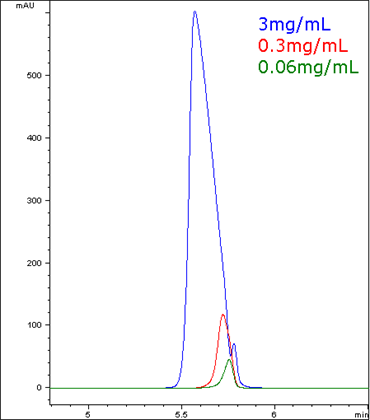
Injection volume is important and should be considered in the method as well.
I
njection Volume Also Matters
Sample concentration is only one component of analyte loading.
Injection volume can have a similar influence on chromatographic performance.
For example:
- A large injection volume of a dilute sample may overload the column.
- A small injection volume of a concentrated sample may also overload the column.
Because total mass on column is important, both variables should be optimized together.
When peak distortion is observed, reducing either:
- Sample concentration
- Injection volume
may improve performance.
HILIC Method Considerations
In HILIC methods, overload effects can be particularly noticeable because:
- Highly retained polar compounds may interact strongly with the stationary phase.
- Sample solvent effects may contribute to peak distortion.
- Injection conditions can significantly affect chromatographic performance.
For this reason, both sample concentration and injection solvent composition should be evaluated during method development.
Impact on Quantitative Analysis
Column overload does more than affect appearance.
It can also affect:
- Peak area reproducibility
- Calibration linearity
- Accuracy
- Precision
- Detection limits
Maintaining operation within the column's linear loading range is important for reliable quantitative analysis.
Troubleshooting Recommendations
When poor peak shape is observed:
Evaluate Sample Concentration
- Prepare and inject a diluted version of the sample.
Examine Injection Volume
- Reduce injection volume and compare the resulting chromatograms.
Monitor Retention Changes
- Look for increases in retention time as sample concentration decreases.
Compare Peak Symmetry
- Evaluate whether peak fronting or distortion improves after dilution.
Verify Method Linearity
- Ensure calibration standards and samples are within the method's validated concentration range.
Key Takeaways
- Excessive sample concentration can overload an HPLC column.
- Column overload often causes reduced retention and distorted peak shapes.
- Both HILIC and reversed phase methods can be affected.
- Injection volume and sample concentration should be optimized together.
- Diluting the sample often improves peak symmetry and chromatographic efficiency.
- Operating within the column's linear loading range improves quantitative accuracy and precision.
