Date: 15-JULY-2015 Last Updated: 6-SEPTEMBER-2026
Introduction
Nucleotides play essential roles in cellular metabolism, energy transfer, and nucleic acid synthesis. They are composed of three fundamental structural components:
- A nitrogen-containing nucleobase
- A five-membered sugar
- One or more phosphate groups
The specific nucleobase present determines the identity and properties of the nucleotide. In the case of inosine-derived compounds, the nucleobase is hypoxanthine, a naturally occurring purine derivative that serves as an important intermediate in nucleotide metabolism.
Components of a Nucleotide
All nucleotides share the same basic structural framework. A nucleotide consists of:
Nucleobase
The heterocyclic nitrogen-containing structure that defines the nucleotide family.
Examples include:
- Adenine
- Guanine
- Cytosine
- Thymine
- Uracil
- Hypoxanthine
Sugar Unit
The sugar component is typically:
- Ribose (RNA-related compounds)
- 2-Deoxyribose (DNA-related compounds)
Phosphate Group
One or more phosphate groups attached to the sugar distinguish a nucleotide from a nucleoside.
Hypoxanthine
Hypoxanthine is the purine nucleobase associated with inosine compounds.
It serves as a key intermediate in:
- Purine metabolism
- Nucleotide biosynthesis
- Nucleic acid degradation pathways
Hypoxanthine itself contains no sugar or phosphate group and therefore is classified as a base rather than a nucleoside or nucleotide.
What Is Inosine?
When a ribose molecule is attached to hypoxanthine through a: β-N9-glycosidic bond the resulting compound is known as:
Inosine
Inosine is classified as a: Nucleoside because it contains:
- Hypoxanthine
- Ribose
but does not contain a phosphate group.
What Is Inosine Monophosphate (IMP)?
When a phosphate group is attached to inosine, the compound becomes: Inosine Monophosphate (IMP). IMP is classified as a: Nucleotide because it contains:
- Hypoxanthine
- Ribose
- Phosphate
IMP is a central metabolite in purine biosynthesis and serves as a precursor for both adenine and guanine nucleotides.
Relationship Between These Compounds
The progression can be summarized as: Hypoxanthine → Inosine → Inosine Monophosphate (IMP). Where:
- Hypoxanthine = nucleobase
- Inosine = nucleoside
- Inosine Monophosphate = nucleotide
The addition of the sugar forms the nucleoside, while addition of the phosphate forms the nucleotide.
Structural Comparison
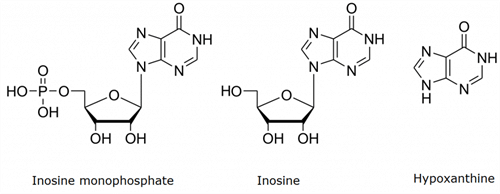
Chemical structures of hypoxanthine, inosine, and inosine monophosphate (IMP), illustrating the progression from nucleobase to nucleoside to nucleotide.
Importance in Chromatography and Biochemistry
Inosine-related compounds are commonly encountered in:
- Pharmaceutical research
- Biochemical studies
- Metabolomics
- Purine metabolism investigations
- LC-MS analyses
- HPLC nucleotide separations
Because of their differing polarity and charge states, hypoxanthine, inosine, and IMP often exhibit significantly different chromatographic behavior.
Nucleosides Versus Nucleotides
A useful distinction is:
Nucleoside
Contains:
- Base + Sugar
Example:
- Inosine
Nucleotide
Contains:
- Base + Sugar + Phosphate
Example:
- Inosine Monophosphate (IMP)
The presence of phosphate groups substantially alters charge, polarity, and retention characteristics during chromatographic analysis.
Conclusion
Inosine nucleotides are derived from the purine base hypoxanthine. When hypoxanthine is attached to ribose, the resulting nucleoside is inosine. Addition of a phosphate group converts inosine into inosine monophosphate (IMP), a biologically important nucleotide involved in purine metabolism. Understanding these structural relationships is valuable in biochemical research, pharmaceutical development, and chromatographic method design.