
Date: 9-January-2015 Last Updated: 16- AUGUST-2026
Overview
When connecting tubing to an HPLC column, one of the most important but often overlooked dimensions is the distance between the ferrule and the end of the tubing. This dimension is commonly referred to by several names, including:
- Pilot Length
- Dimension X
- Stop Depth
- Seating Depth
Although different manufacturers may use different terminology, these terms all describe the same fundamental concept.
Pilot length determines how far the tubing extends beyond the ferrule and into the column connection port. For optimal chromatographic performance, the tubing should seat precisely against the bottom of the column inlet or outlet without creating dead volume or mechanical misalignment.
Why Pilot Length Matters
Modern HPLC and UHPLC systems depend on low-dead-volume connections to preserve column efficiency.
If the tubing does not properly contact the bottom of the column port, additional volume is introduced into the flow path. This extra volume can cause:
- Peak broadening
- Loss of efficiency
- Reduced resolution
- Retention time variability
- Increased system dispersion
Similarly, if the tubing extends too far into the port, the ferrule may not seat correctly, resulting in misaligned flow paths and possible leakage.
Both conditions negatively affect chromatographic performance.
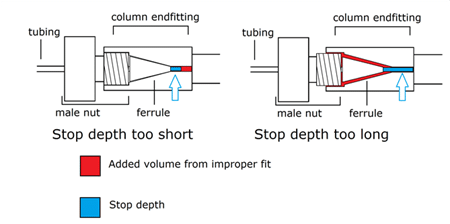
Effects of Incorrect Pilot Length
Pilot Length Too Short
When the tubing does not reach the bottom of the column port:
- A gap is created between the tubing and the column inlet.
- Additional dead volume is introduced.
- Sample bands expand before entering the column.
- Resolution and efficiency may decrease.
Pilot Length Too Long
When the tubing extends beyond the optimal insertion depth:
- The ferrule may not seat correctly.
- Flow paths can become misaligned.
- Connections may leak.
- Band broadening may occur.
In either case, chromatographic performance suffers because the connection is no longer optimized.
Variations Between Column Manufacturers
One reason pilot length adjustment has historically been challenging is that different manufacturers use different port depths.
A fitting configured correctly for one brand of column may not provide an optimal connection when used with another manufacturer’s hardware.
Typical reported stop depths include:
| Column Hardware Type | Reported Stop Depth |
|---|---|
| Cogent™ | 0.09 in |
| Parker Type | 0.09 in |
| Valco® | 0.08 in |
| Waters® | 0.13 in |
Because these dimensions differ, transferring columns between systems may require fitting adjustments to maintain proper engagement.
Adaptive Fitting Technology
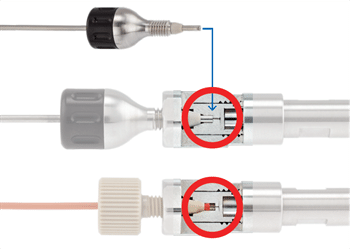
Spring-loaded adaptive fittings were developed to eliminate the need for manual pilot length adjustment.
Direct Adaptive (Di-Ad™) fittings automatically compensate for differences in column port depth by adjusting the tubing position during installation.
Benefits include:
- Automatic optimization of pilot length
- Reduced dead volume
- Faster column changes
- Improved compatibility between column brands
- Reduced risk of leaks
- Improved chromatographic reproducibility
This approach simplifies installation while maintaining high-performance fluidic connections.
Best Practices for Column Connections
To achieve optimal performance:
- Minimize dead volume at all connections.
- Verify tubing cuts are clean and square.
- Use fittings compatible with the column hardware.
- Replace worn ferrules and tubing when necessary.
- Consider adaptive fittings when routinely changing column brands.
Attention to these details can significantly improve peak shape, efficiency, and overall chromatographic performance.
Key Takeaways
- Pilot Length, Stop Depth, Seating Depth, and Dimension X describe the same connection parameter.
- Proper tubing engagement is essential for minimizing dead volume.
- Pilot lengths that are too short or too long can cause band broadening and leakage.
- Different column manufacturers use different port depths.
- Di-Ad™ fittings automatically adjust to varying column inlet and outlet depths.
- Proper fluidic connections help maximize column efficiency and chromatographic performance.
Additional Resources
For adaptive fittings, low-dead-volume connections, column hardware compatibility, and installation guidance, view: