
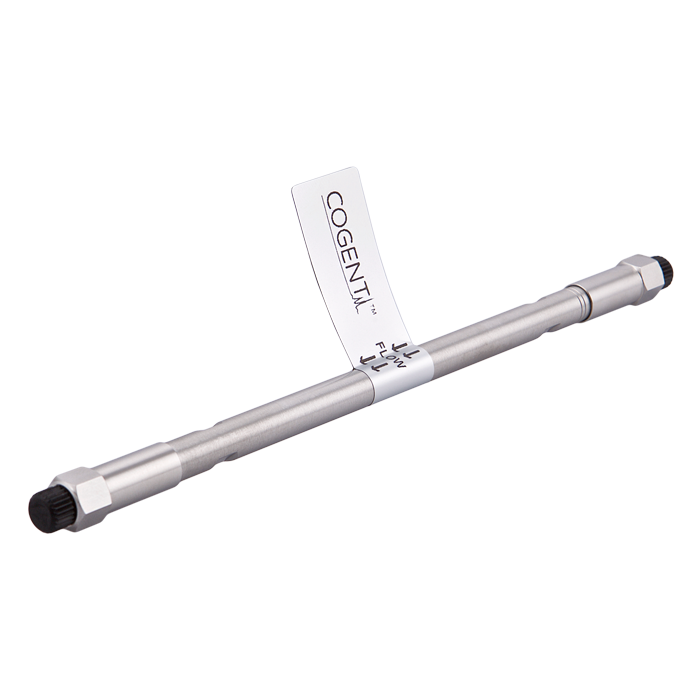
HPLC Column, Bidentate C8, 4um, 4.6mm ID x 150mm Length, 100A. Cogent TYPE-C Brand. 1 EA.
Additional Information:
The 40008‑15P Cogent Bidentate C8™ HPLC Column is a long‑format analytical reversed‑phase column designed for separations requiring higher resolving power than shorter formats while maintaining alternative selectivity relative to C18. Built on Cogent TYPE‑C™ silica hydride technology, this column delivers excellent selectivity, faster equilibration, and extremely robust column lifetime compared with conventional silica‑based C8 columns.
The stationary phase consists of an aliphatic C8 hydrocarbon chain bonded via two direct silicon–carbon bonds (bidentate attachment) to a silica hydride surface. This non‑traditional chemistry produces a phase that is more hydrophobic than standard C8 columns, yet less hydrophobic than Bidentate C18™, providing a well‑balanced option when C18 retention is excessive. Unlike traditional C8 columns, this phase can also retain select hydrophilic compounds, expanding the usable method window.
The 150 mm column length increases plate count and separation efficiency, making this column one of the preferred formats for analytical HPLC using UV detection, particularly with UV‑absorbing compounds that benefit from improved baseline separation. The column is also stable at very low pH (below pH 2) without degradation, enabling aggressive analytical methods not suitable for conventional silica C8 phases.
Why Choose the 4.6 × 150 mm Bidentate C8™ Format
This column size is commonly selected when:
Maximum analytical resolution is required
100 mm columns do not fully resolve critical pairs
C18 chemistry is overly retentive or slow
Standard analytical flow rates and UV detection are preferred
The 150 mm length provides expanded resolving power while TYPE‑C™ silica hydride chemistry maintains fast equilibration and long column life despite the longer format.
Key Features
Cogent TYPE‑C™ Silica Hydride Technology
Non‑traditional reversed‑phase surface chemistry
Reduced silanol activity and secondary interactions
Faster equilibration than conventional silica‑based C8 columns
Extremely robust and reproducible performance
Bidentate C8™ Bonding
Two‑point attachment via direct Si–C bonds
Balanced hydrophobic retention
Alternative selectivity when C18 is overly retentive
Maximum‑Resolution Analytical Geometry
4.6 mm ID × 150 mm length
High plate count for demanding separations
Compatible with standard analytical HPLC systems
Broad Method Flexibility
Stable at very low pH (below 2)
Compatible with aqueous‑rich mobile phases
Suitable for aggressive and unconventional analytical methods
Typical Applications
Analytical HPLC with UV detection
UV‑absorbing compounds
Situations where C18 retention is excessive
High‑resolution reversed‑phase separations
Method development and optimization
Low‑pH analytical methods