
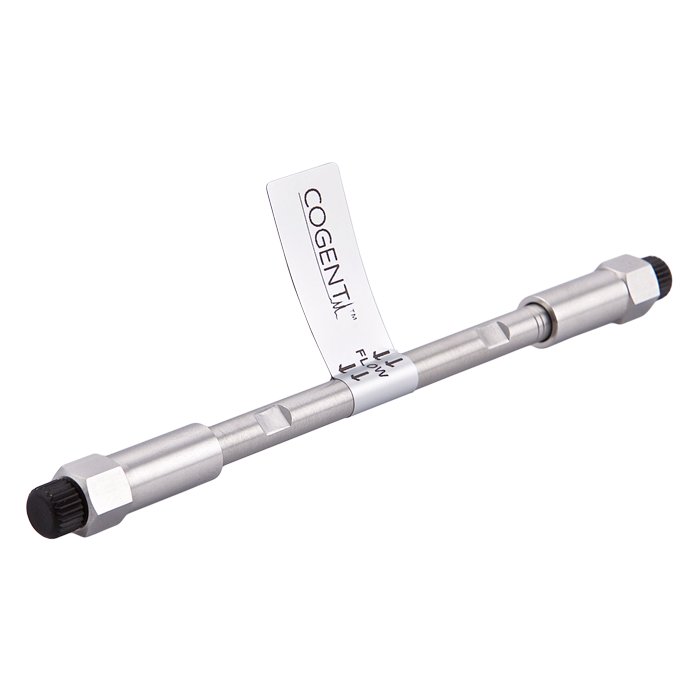
HPLC Column, Diol, 4um, 2.1mm ID x 100mm Length, 100A. Cogent TYPE-C Brand. 1 EA.
Additional Information:
The 40060‑10P‑2 Diol HPLC Column is manufactured using Cogent TYPE‑C™ silica hydride technology, providing excellent selectivity, faster equilibration, and robust column lifetime compared to conventional bonded‑silica diol phases. The 4 µm silica hydride particles deliver dependable chromatographic performance with moderate backpressure, supporting routine analytical and LC‑MS applications.
The TYPE‑C™ surface chemistry enables stable and reproducible retention behavior across reversed‑phase (RP), normal‑phase (NP), and HILIC methods, making this column a versatile solution for polar compound analysis.
Application Focus: Diol Chemistry for Polar Compounds
Diol stationary phases are commonly selected for the analysis of polar analytes that are difficult to retain using reversed‑phase chromatography. The 40060‑10P‑2 column is effective for a wide range of compounds, including:
Polar and non‑polar peptides
Amino acids
Polar metabolites
Small biological and biomolecular species
This chemistry enables flexible method development across multiple chromatographic modes without changing column platforms.
Cogent TYPE‑C™ Silica Hydride Advantages
Compared with traditional bonded‑silica Diol columns, the TYPE‑C™ silica hydride surface provides meaningful operational benefits:
Faster equilibration, particularly in HILIC methods
Excellent selectivity for polar and mixed‑polarity compounds
Improved durability and column lifetime
Reduced susceptibility to silica hydrolysis
These characteristics make the 40060‑10P‑2 well suited for repeated use in LC‑MS laboratories requiring consistency and robustness.
Why Choose the 2.1 mm × 100 mm Format
The 100 mm length provides increased resolving power compared to shorter formats, while the 2.1 mm internal diameter maintains LC‑MS compatibility. This configuration is optimized for:
Improved resolution of complex polar mixtures
Balanced run times with enhanced separation confidence
Reduced solvent consumption compared to larger‑diameter columns
Improved MS sensitivity with lower flow delivered to the source
This size is a popular choice for LC‑MS workflows where both resolution and efficiency are important.
Particle Size and Performance
The 4 µm particle size offers a practical balance between efficiency and robustness, providing:
Consistent chromatographic performance
Lower backpressure than sub‑3 µm formats
Broad compatibility with standard HPLC systems
This makes the column especially suitable for routine and semi‑complex LC‑MS analyses.
LC‑MS‑Focused Operation
The narrow‑bore geometry supports LC‑MS workflows by:
Delivering sharp, symmetrical peaks
Reducing solvent load to the MS source
Supporting reliable quantitative performance
These features contribute to its popularity in LC‑MS and LC‑MS/MS applications.
System Requirements and Flow Rates
Typical flow range (2.1 mm ID): ~0.2–0.3 mL/min
System capability: Requires stable, accurate low‑flow delivery
Important note: Not all standard HPLC systems are optimized for precise low‑flow operation
Flow‑rate optimization should consider solvent composition, viscosity, column temperature, and system pressure limits.