Nucleotides AMP NAD NADP and DTP Analyzed by HPLC - AppNote
July 19, 2013
/
/
/
/
/
Date: 19-JULY-2013 Last Updated: 22-AUGUST-2026
AMP, NAD, NADP, and GTP Nucleotides on UDA Column
Nucleotides are not well retained under Reversed Phase conditions due to their highly polar nature (the presence of one or more Phosphate groups). In this method, weak cation-exchange interactions can provide additional retention/selectivity along with the HILIC retention of the Hydride surface.
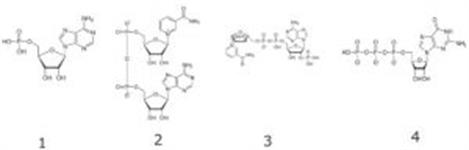
Peaks:
1. AMP – Adenosine 5’-Monophosphate
2. NAD - Beta-nicotinamide Adenine Dinucleotide
3. NADP – NAD - Phosphate
4. GTP - Guanosine 5’ - Triphosphate
Column: Cogent UDA™, 4 µm, 100 Å
Catalog No.: 40031-05P-2
Dimensions: 2.1 x 50 mm
Mobile Phase:
-- A: DI Water / 16.0 mM Ammonium Acetate
-- B: 90% Acetonitrile / 10% DI Water / 16.0mM Ammonium Acetate
Gradient:
| Time (minutes) | %B |
|---|---|
| 0 | 95 |
| 0.5 | 95 |
| 10 | 75 |
| 15 | 30 |
| 20 | 30 |
| 20.1 | 95 |
Temperature: 25˚C
Post Time: 3 minutes
Injection vol.: 1 µL
Flow rate: 0.4 mL / minute
Detection: UV @ 254 nm
Sample Preparation: Stock Solution: 1 mg / mL solutions in DI Water. Samples were diluted 1:10 into 50% Acetonitrile / 50% DI Water mixture. Before injection, samples were filtered through a 0.45 µm Nylon Syringe Filter (MICROSOLV Tech Corp.).
t 0 : 0.7 minutes
Note: The ratio of NAD to NADP has biological relevance when studying redox profiling and redox potential in the study of new generation NAD depleting Cytotoxic drugs. For metabolic screening, the Erythrocytes of Lesch–Nyhan Disease patients have grossly raised levels of NAD relative to NADP, while GTP is very low. Sensitive assay of GTP levels is also relevant to binding studies of G-proteins.